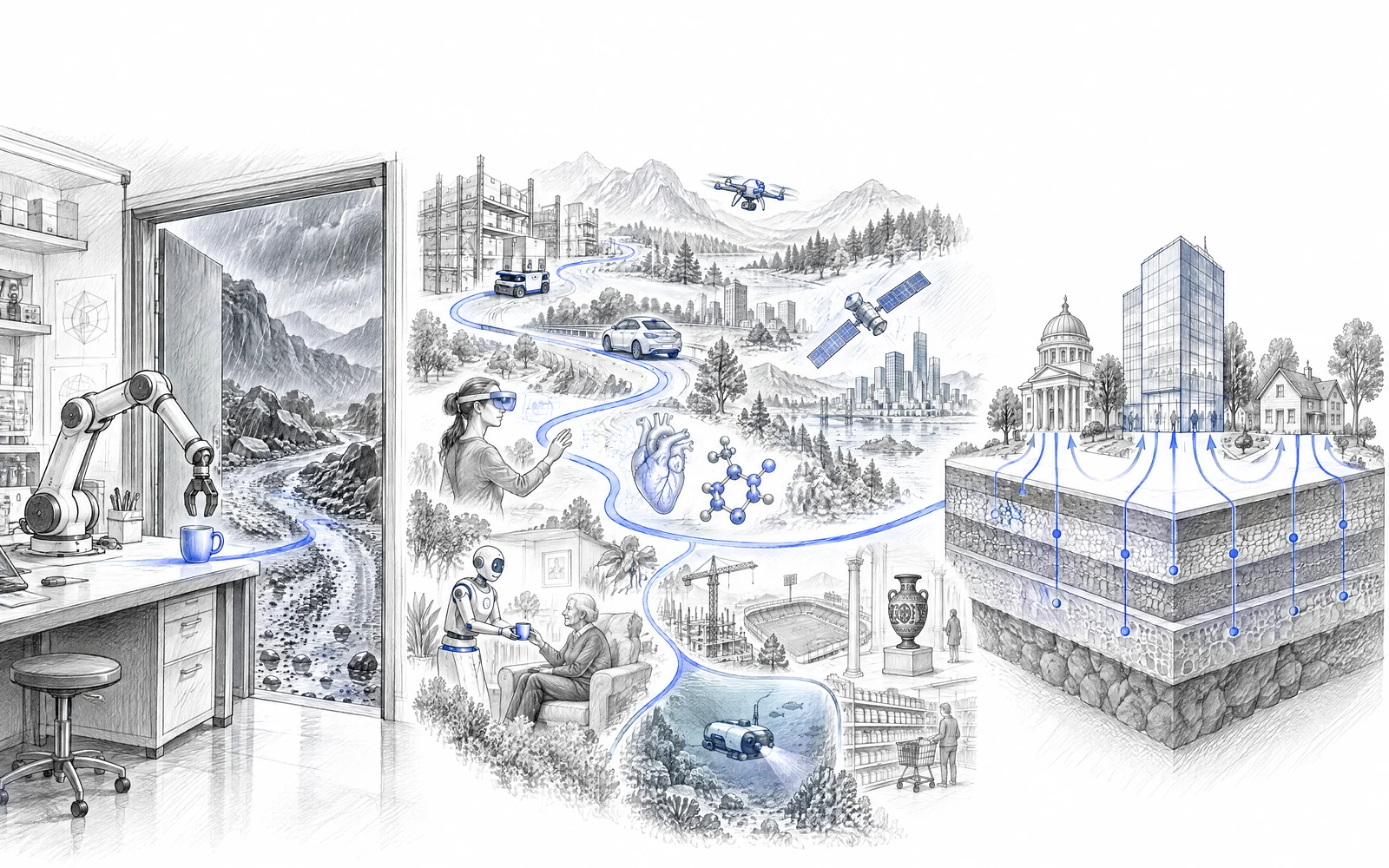
The preceding parts built spatial intelligence as a set of capabilities; this part asks what those capabilities are worth once they leave the laboratory. Applications are not a victory lap over Parts II and III but a stress test: a method that reconstructs a scene cleanly on a benchmark must, in the field, do so under a latency budget, a safety constraint, a sensor that fails, or a cost of error measured in more than accuracy. What a domain demands of spatial intelligence, and what it reveals about the gaps that remain, is visible only at deployment.
This part is therefore organized by domain rather than by capability, because the interesting content lives in the delta each domain adds over a general treatment. The tour runs from embodied agents that must act in the physical world, through the extended-reality systems that render it back to a user in real time, to the geo-spatial and scientific settings that model it at the scale of planets and of cells, to the assistants that inhabit a person’s own environment, and out into a long tail of further fields. Each stresses spatial intelligence along a different axis: real-time action, on-device perception, metric fidelity, human-centered interaction. Read together, they make the case that spatial intelligence is not one more application but a horizontal foundation on which applications across science, industry, and daily life are increasingly built.