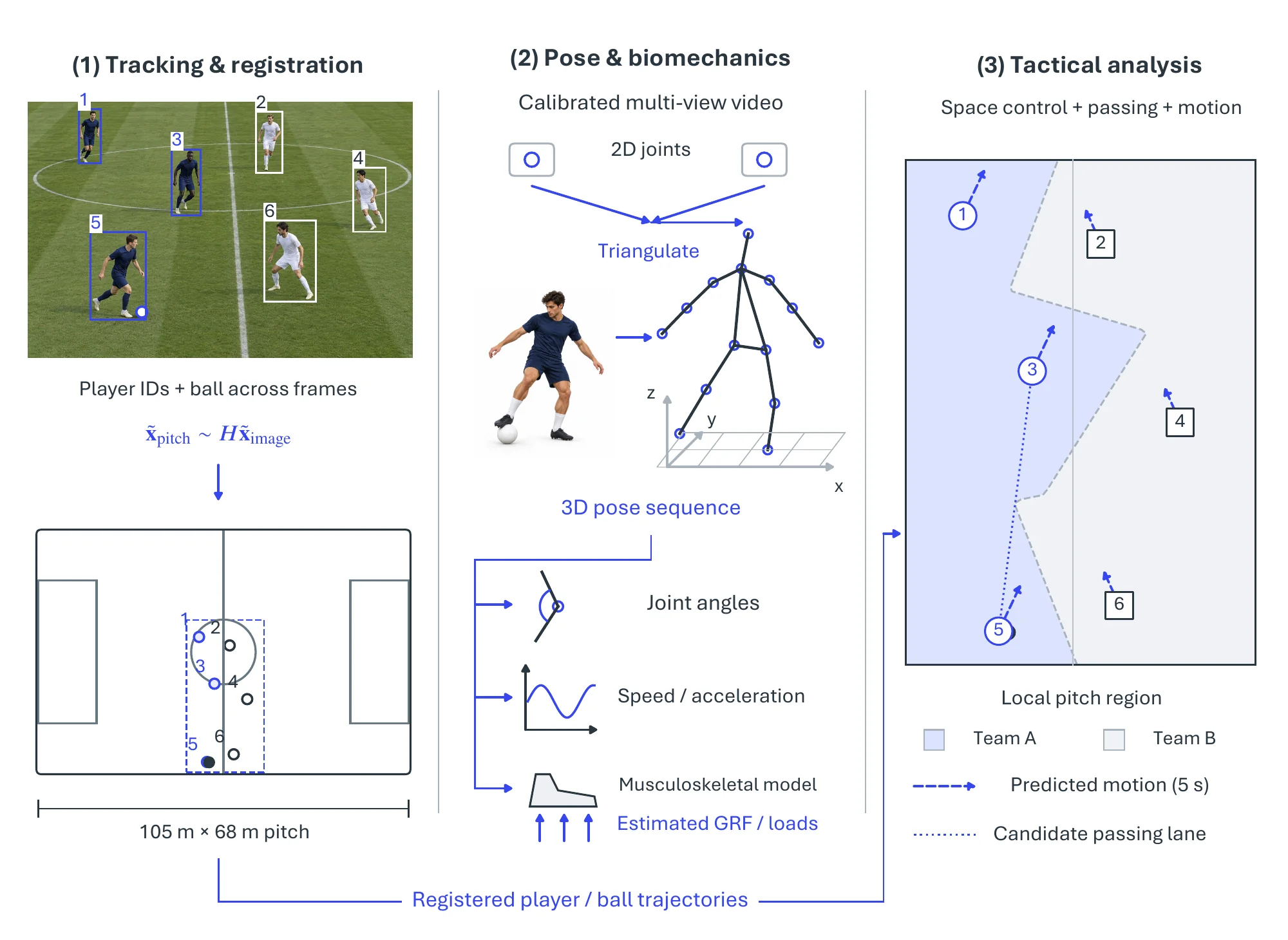
Sports analytics lifts raw broadcast or arena video into a calibrated metric model of the playing surface, then reasons over the resulting positional field. What sets it apart is fine-grained, multi-agent spatiotemporal tracking under severe and persistent occlusion, where many near-identical players and a small fast ball must be followed and assigned consistent identities at sub-second resolution. Figure 14.2 illustrates three linked capabilities: registered trajectories feed tactical analysis, while calibrated multi-view pose supports biomechanics. Tracking and registration form the geometric foundation: multi-object tracking benchmarks such as SoccerNet-Tracking [2980] and the multi-sport SportsMOT [2981] drive player and ball association, while sports-field registration estimates the homography from the broadcast frame to a metric pitch template so that pixel positions become field coordinates [2982]. 3D pose and biomechanics recover athlete motion in three dimensions, with markerless capture systems estimating not only kinematics but joint dynamics from ordinary video, as in OpenCap [2983], typically by triangulating multi-view 2D pose into a 3D skeleton [538]. Tactical and team-space analysis then treats the positional field itself as the object of study, valuing the space each player controls and forecasting where players will move; deep models of expected possession value [2984] and multi-agent trajectory generation [2985] build directly on the spatial-reasoning methods of Chapter 7. The deployed layer is mature, spanning optical tracking and officiating from Hawk-Eye,1 player-tracking data from Second Spectrum (now part of Genius Sports)2 and Stats Perform,3 and wearable spatial sensing from KINEXON4 and Catapult.5