9.5.1Introduction#
Warehouse and industrial logistics is one of the most mature real-world testbeds for the spatial capabilities surveyed in Part III: it demands perception-to-action pipelines that interpret complex, dynamic environments such as dense shelving systems populated with diverse stock keeping units (SKUs), pallets, forklifts, and human workers. These systems construct and maintain spatial memory representations (semantic maps, object and pose states) to support downstream planning and manipulation for tasks including inventory counting, order picking, pallet handling, and coordinated fleet operations. Perception and reasoning themselves are treated in Chapter 6 and Chapter 7; logistics adds throughput targets, engineered but crowded layouts, and people sharing the floor with fleets of robots. Performance is judged in terms of throughput, order accuracy, safety, and operational cost, especially under high SKU diversity, visual clutter, elongated aisles, and human-robot collaboration. Dense shelving and manipulation in clutter remain the hardest cases, as the Amazon Picking Challenge made plain [2625], and they demand that perception, pose estimation, mapping, and multi-agent planning be integrated rather than tuned in isolation.
9.5.2System Overview#
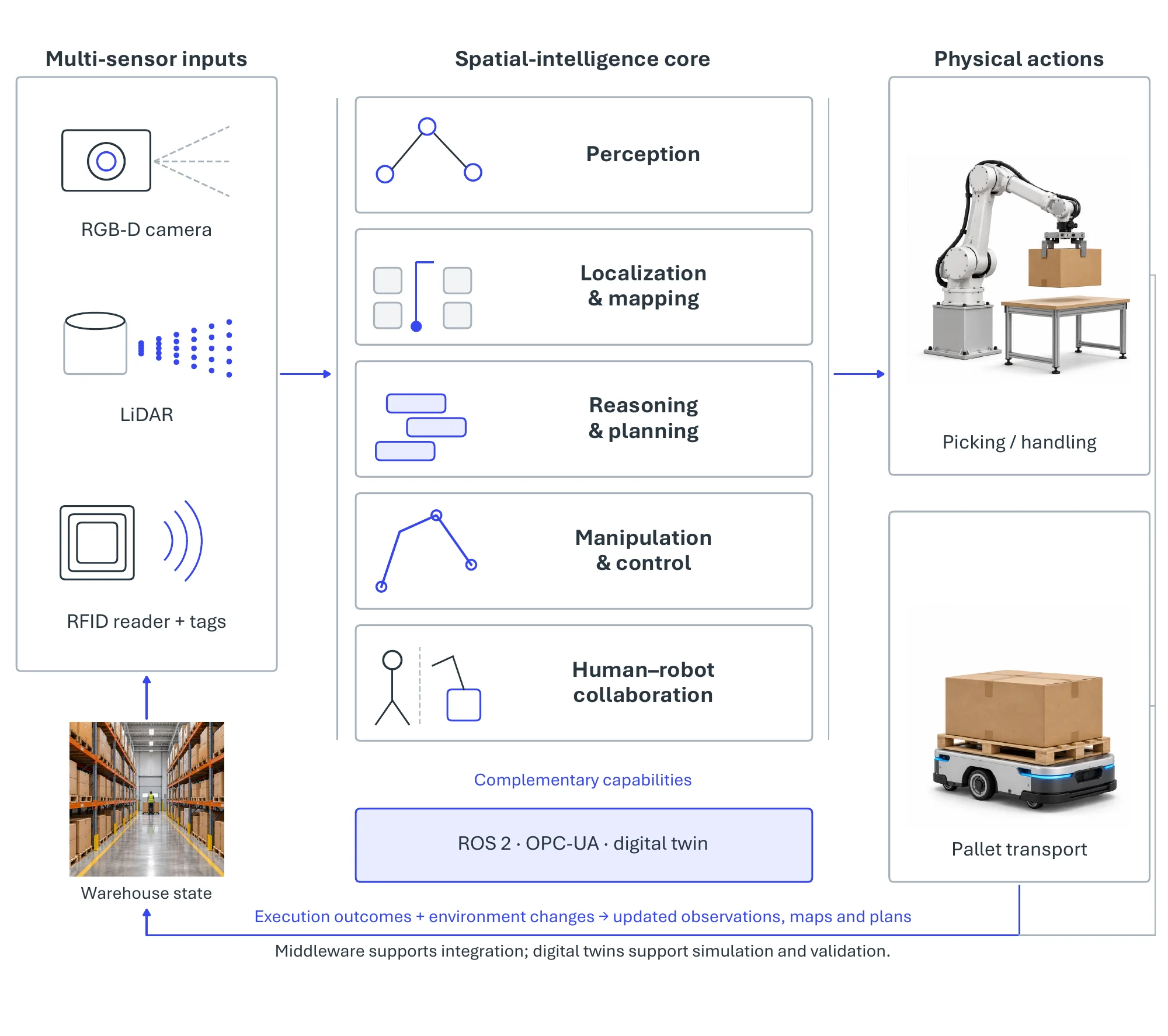
The complete warehouse automation pipeline, sketched in Figure 9.19, integrates five complementary capabilities into a closed loop. Perception converts raw multi-sensor streams into semantic object information (what is present, where, and in what pose); localization and mapping grounds that information in a metric spatial map and keeps it consistent over time; reasoning and planning consume these representations to allocate tasks and generate optimized fleet schedules; manipulation and control physically execute the resulting picking and transport actions; and a human-robot collaboration and safety layer adapts behavior dynamically in mixed human-robot environments. Integration is achieved via middleware such as ROS 2 and industrial protocols like Open Platform Communications Unified Architecture (OPC-UA), while digital twin platforms such as NVIDIA Omniverse1 support simulation and validation before deployment. The five capabilities are the pivotal tasks below, taken in pipeline order.
9.5.3Pivotal Task-1: Perception and Recognition#
Perception constitutes the sensory foundation of the pipeline: it transforms raw sensor data into actionable knowledge, reusing the detection, segmentation, and pose-estimation machinery of Chapter 6 but specializing it to the warehouse Operational Design Domain. Core capabilities include detecting and classifying objects (packages, pallets, tools), estimating their 3D poses, and tracking their motion and state over time. Unlike outdoor environments, warehouses impose distinct perceptual challenges: dense clutter, heavy occlusion, visually similar items, reflective packaging, narrow aisles, and continually changing layouts, which together make robust perception a central and ongoing research focus [2626, 130]. Formally, perception is a structured mapping from a synchronized multimodal stream (together with calibration parameters and a prior map ) to a scene graph , in which each detected object carries a class label , a bounding box or segmentation mask , an estimated pose , and an uncertainty measure that grounds subsequent manipulation, navigation, and decision making. Figure 9.20 sketches this representation stack.
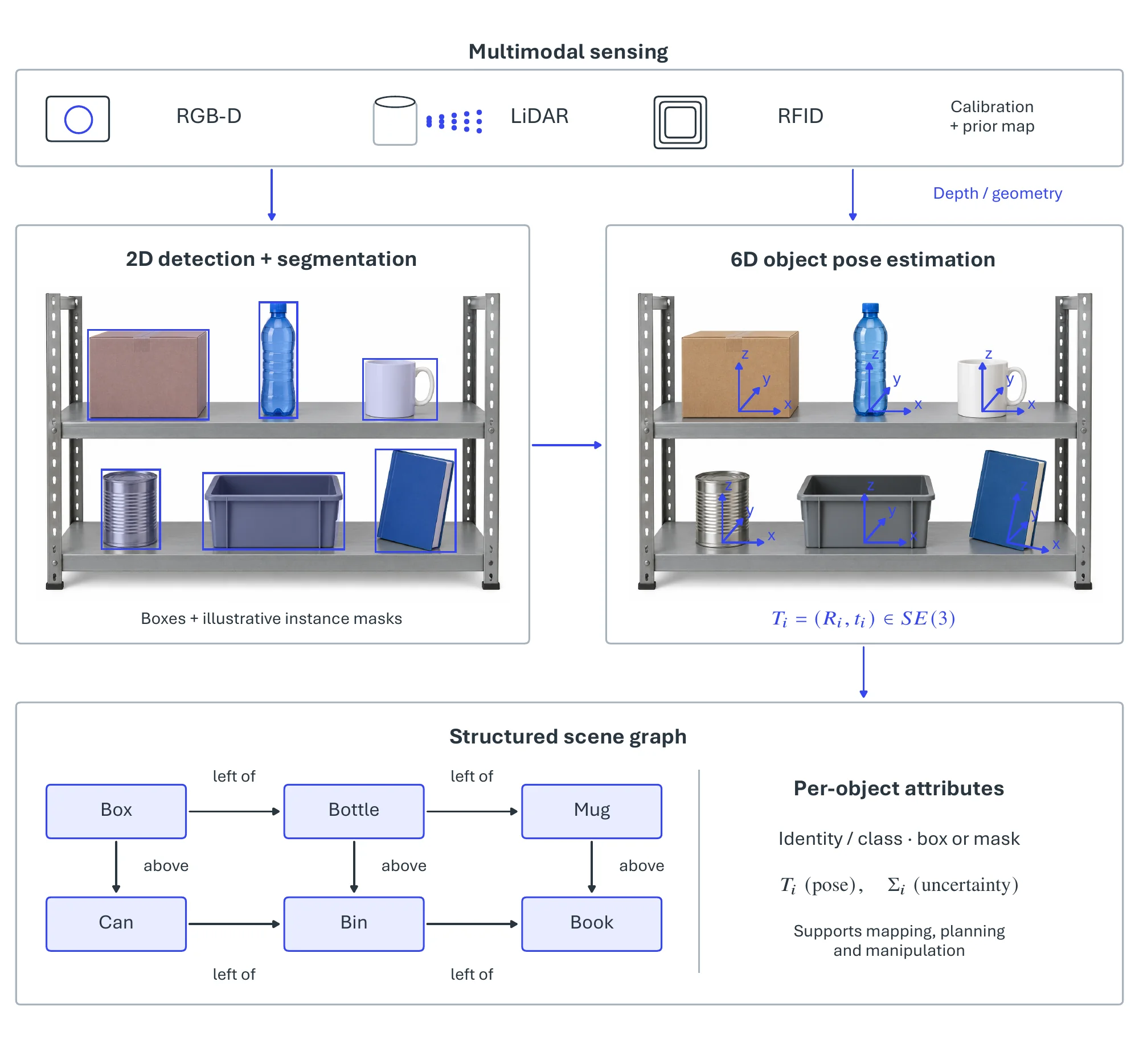
Detection and recognition form the base layer. Convolutional and transformer-based architectures, i.e., , YOLO [130], RetinaNet [412], and the transformer-based DETR with deformable attention [415], have steadily improved accuracy and efficiency under clutter, and are scored on COCO [440], whose mean Average Precision (mAP) broken down by object size is particularly informative for the small-SKU and barcode-label cases that dominate warehouse failure modes. Pose estimation lifts these 2D detections into the metric space that manipulation requires: PoseCNN [737], DenseFusion [740], and CosyPose [746] fuse visual and geometric cues to infer six-degree-of-freedom (6D) orientation and position even under occlusion, and are evaluated on YCB-Video [737] for textured household and industrial objects and on T-LESS [768] for textureless, industry-relevant parts, with Average Distance (ADD) the standard accuracy measure and MOTA/MOTP reporting tracking quality in dynamic scenes. The Amazon Picking Challenge [2625] couples perception with manipulation in real warehouse scenarios, stressing generalization across novel object sets and thereby anticipating the manipulation task of §9.5.6 below. Representative benchmarks across the section are consolidated in Table 9.9. In industrial practice, perception pipelines are increasingly standardized and modularized; the deployed software stacks that realize them are surveyed in the Established Tools and Systems subsection.
9.5.4Pivotal Task-2: Localization and Mapping#
If perception answers what is around the robot, localization and mapping answer where the robot is and what the persistent structure of the warehouse is, forming the spatial backbone on which fleet coordination rests and drawing on the same scene-construction techniques as Chapter 6. Automated guided vehicles (AGVs) and autonomous mobile robots (AMRs) require centimeter-level accuracy to navigate narrow aisles, dock precisely at shelves, and operate safely alongside workers. The problem is conceptually the SLAM problem of autonomous driving, yet it faces warehouse-specific constraints: highly repetitive structures (rows of identical shelves), dynamic obstacles (workers, pallets, forklifts), and low-light or GPS-denied indoor conditions. Formally, a sequence of odometry and sensor measurements , optionally supplemented by a prior map or fiducial anchors, is fused into a pose graph that estimates the trajectory and an evolving semantic map fusing geometric structure with storage zones and restricted areas. Beyond navigation, this map underpins the digital twins (continuously updated spatial models used for simulation, optimization, and predictive planning) that increasingly govern modern facilities [2627]. Figure 9.21 casts the task as a multi-sensor fusion problem.
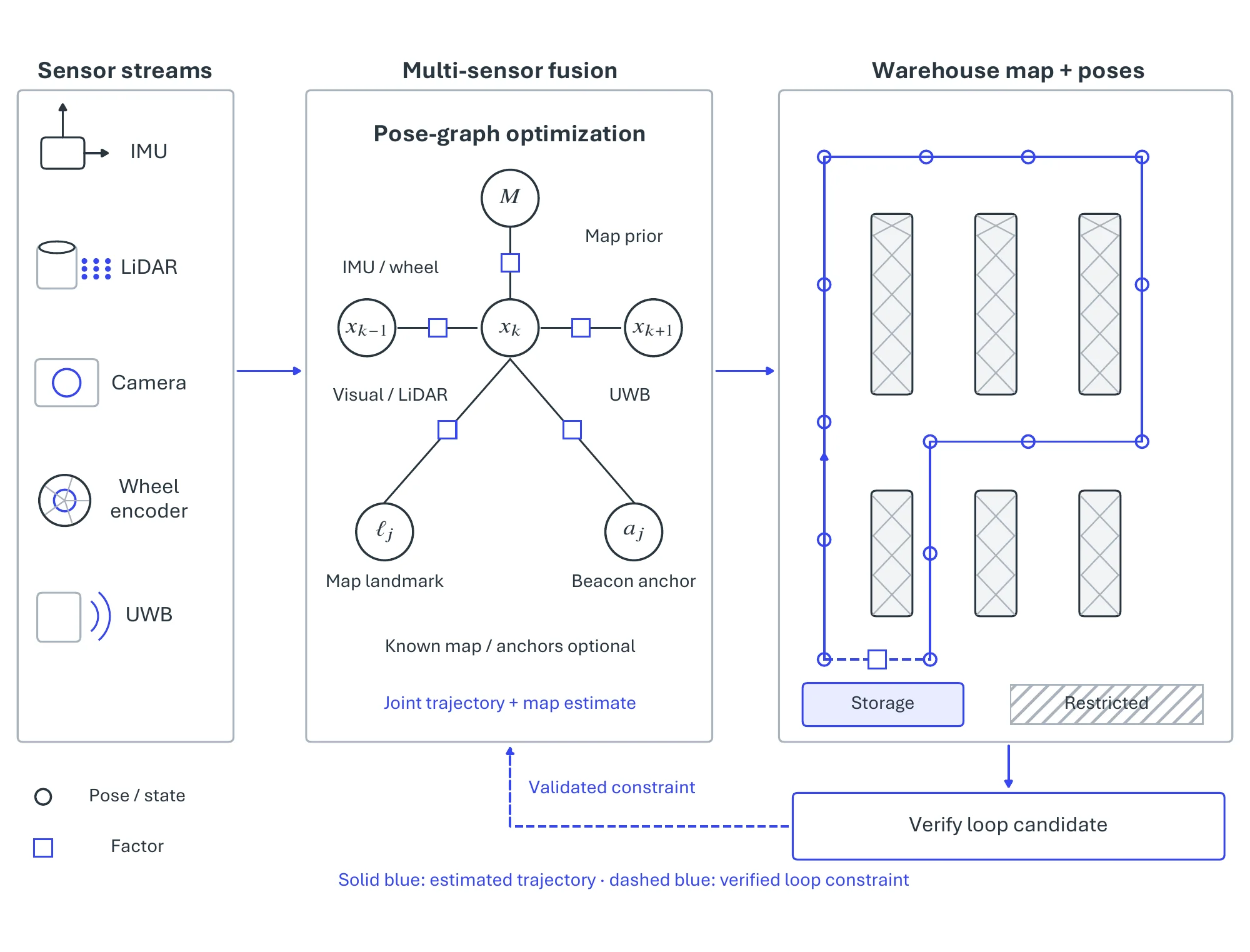
A family of SLAM algorithms has been tailored to these conditions. ORB-SLAM3 [736] extends visual SLAM with inertial and multi-camera support for accurate visual-inertial localization; LIO-SAM [2628] provides real-time LiDAR–IMU fusion through factor-graph optimization that stays robust under fast motion and partial occlusion; and RTAB-Map [2629] supports online RGB-D mapping and loop-closure detection with memory management suited to long-term operation, all expressible within the unified factor-graph framework of GTSAM [2630]. Multi-modal fusion is the common thread that holds accuracy together when any single modality degrades, and is also the dominant emerging research direction, alongside learning-based estimation (neural depth prediction, differentiable bundle adjustment, and learned place-recognition embeddings) and the migration of SLAM computation to the edge for fleet-scale latency. These capabilities are evaluated on KITTI [653] for outdoor visual and LiDAR odometry and loop closure, on the indoor visual-inertial EuRoC MAV dataset [733] whose challenging motion and illumination mirror warehouse conditions, and on the high-fidelity Replica reconstructions [339] for dense mapping and semantic labeling, with Absolute and Relative Pose Error (APE/RPE) and loop-closure precision/recall the standard metrics and, for warehouse use, semantic-zone IoU and map completeness (Table 9.9).
9.5.5Pivotal Task-3: Reasoning and Planning#
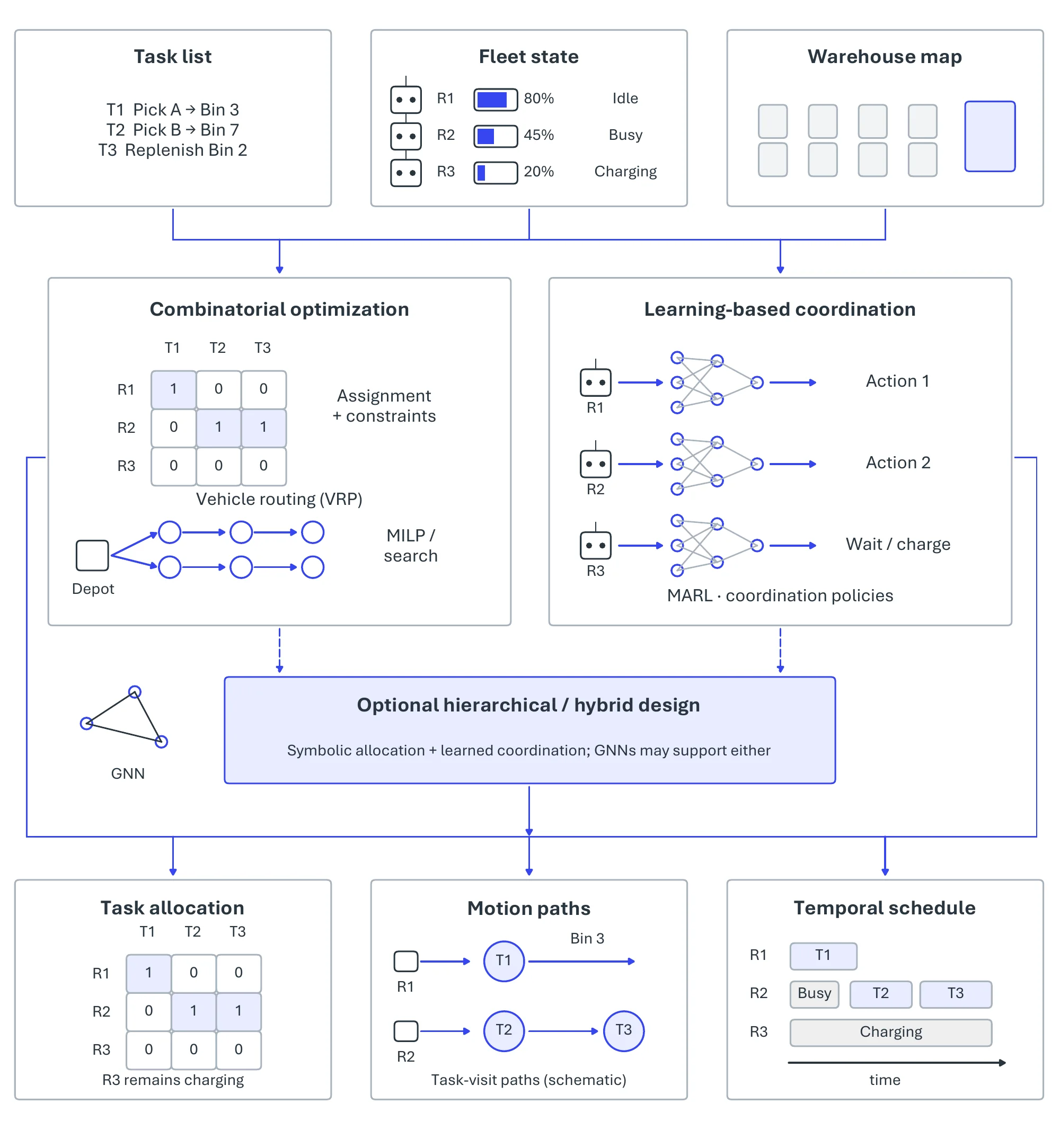
Reasoning and planning form the decision-making core of warehouse automation, transforming the perceptual and localization outputs into task assignments and motion plans, and instantiating the spatial-reasoning and planning paradigms of Chapter 7. This layer determines which robot executes which task, how tasks are sequenced, and how routes and schedules are optimized for safe, efficient, coordinated operation. In contrast to autonomous driving, where planning typically focuses on individual vehicles, warehouse reasoning must address multi-agent coordination across fleets of dozens or hundreds of robots in constrained indoor space [2631], maximizing throughput and minimizing latency while maintaining safety under dynamic obstacles, human interactions, and stochastic task arrivals. Formally, the perceived states , a task list , the fleet state (positions, capabilities, battery levels), and the warehouse map are mapped to a task-allocation matrix , optimized motion paths , and temporal schedules that jointly specify when and how tasks execute. Figure 9.22 contrasts the two solution families.
The first family is combinatorial optimization. Traditional methods (the Hungarian algorithm, branch-and-bound, and mixed-integer linear programming) remain widely used for task allocation and scheduling in small- to medium-scale deployments, while Vehicle Routing Problem (VRP) formulations [2632] and their multi-depot and time-window variants are central to modeling fleet movement. The second family is learning-based coordination: reinforcement learning (RL) and multi-agent RL (MARL) handle dynamic environments and real-time uncertainty [2633, 1435], with toolkits such as Google OR-Tools [2634] and PyMARL enabling rapid experimentation across both families. Emerging research couples the two: hierarchical and hybrid frameworks combine symbolic reasoning with learned components, graph neural networks and differentiable optimization accelerate multi-agent coordination and transfer policies across layouts, and digital-twin integration enables simulation-informed, predictive re-planning, increasingly under multi-objective criteria that balance throughput, energy, and human safety. Planning systems are benchmarked on Solomon’s VRP suite [2635] for static routing and scheduling and on the Open Motion Planning Library (OMPL) [1272] for continuous-space motion planning, complemented by synthetic multi-robot testbeds; common metrics are throughput (items/hour), task-completion latency, total travel distance or time, collision rate, and re-planning latency (Table 9.9).
9.5.6Pivotal Task-4: Manipulation and Control#
Manipulation constitutes the physical execution layer, enabling robots to interact directly with objects, containers, and infrastructure such as bins, shelves, and conveyors. In industrial logistics this typically involves robotic arms performing grasping, placing, sorting, or palletizing, as well as AGVs docking to pallets or workstations. Manipulation bridges high-level symbolic or geometric plans with continuous motor control, and therefore demands both precision and robustness to the inherent variability in packaging, geometry, and material properties [35]; the grasping and control techniques here connect directly to the robotic-manipulation treatment of §9.1 and the planning paradigms of Chapter 7. Formally, estimated object poses and task descriptions (grasp targets, placement goals, trajectory constraints) are mapped to low-level motor commands that ensure stable grasping, precise placement, and compliant, collision-free motion. Figure 9.23 contrasts modular grasp-and-plan systems with learned visuomotor control.
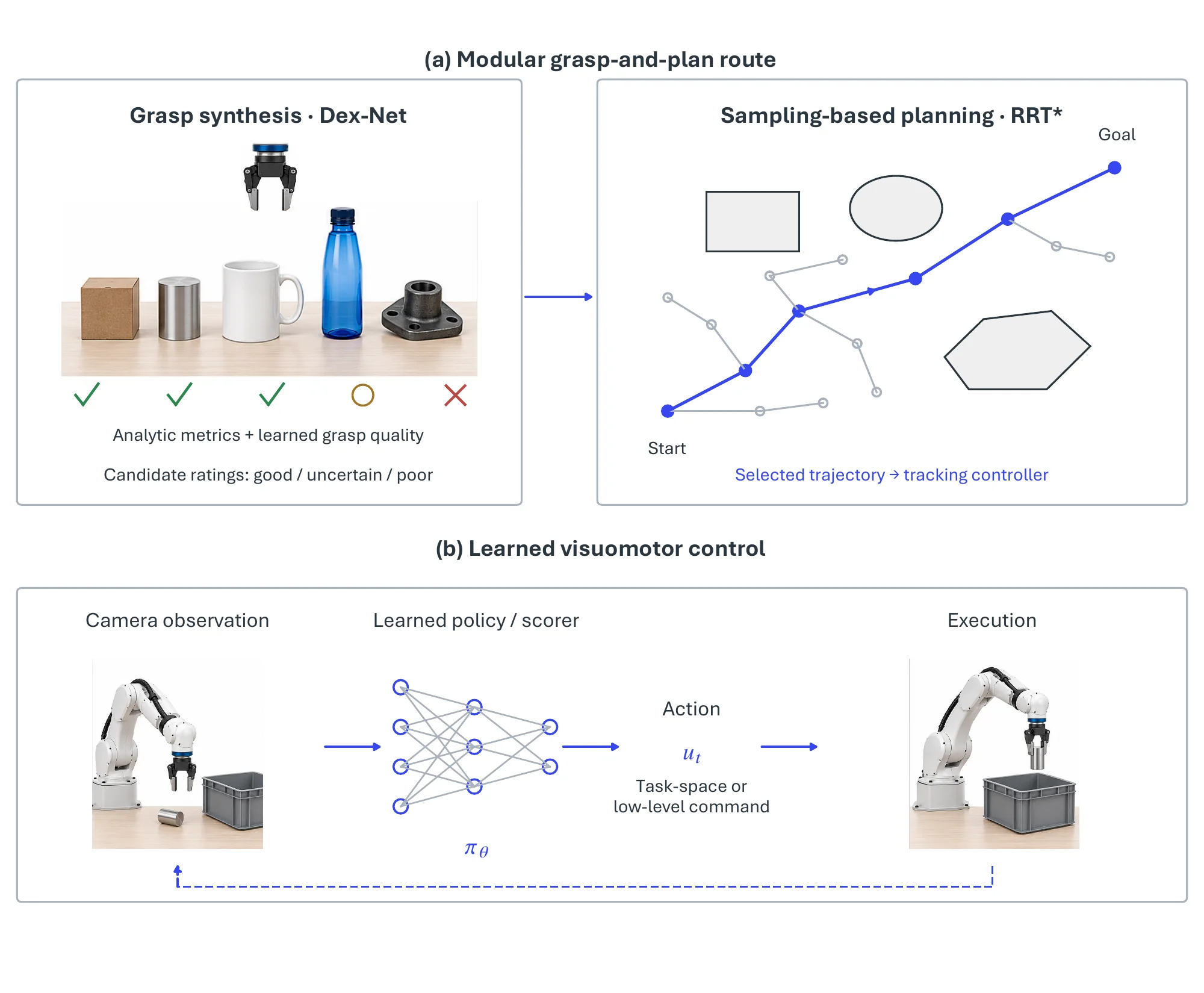
Grasp synthesis anchors the methodology: Dex-Net combines synthetic grasp data and analytic robustness metrics to train a grasp-quality predictor for candidate selection [336], while learned visual control can predict grasp success from camera images and candidate task-space motions, then select actions for adaptive manipulation [35]. Motion planning then realizes the chosen grasp: sampling-based algorithms such as RRT* [1223] remain fundamental for generating collision-free trajectories in high-dimensional configuration spaces, exposed through frameworks like MoveIt [2636]. These capabilities are benchmarked on the Amazon Picking Challenge [2625], which established a standardized testbed for picking under clutter and uncertainty, and on the YCB Object and Model Set [1184], a diverse collection of everyday items with physical models for grasping and manipulation; grasp success rate, cycle time per pick, placement accuracy, and task-completion rate are the headline metrics (Table 9.9). Hybrid control frameworks that combine analytical models with data-driven adaptation are emerging as the practical route to generalizing across variable geometries and grasp contexts, complemented by tactile sensing and force control for slip detection and contact regulation.
9.5.7Pivotal Task-5: Human-Robot Collaboration and Safety#
Even in highly automated warehouses, human workers remain indispensable for complex, dexterous, or exception-handling tasks that require contextual understanding and flexible decision making, so the final stage of the pipeline is safe and efficient human-robot collaboration (HRC). HRC systems must balance productivity with stringent safety guarantees, enabling mixed teams (robots handling repetitive or heavy-load work, humans managing fine-grained, judgment-based activities) to share workspaces without physical or operational interference [2637]. The task maps multimodal human-detection and intent signals (pose, gesture, gaze, and trajectory data from vision, LiDAR, wearables, or motion capture) to adaptive robot behaviors such as dynamic speed modulation, path re-routing, stop-and-wait actions, or task reallocation in response to predicted human movement. Figure 9.24 sketches this predict-then-adapt loop.
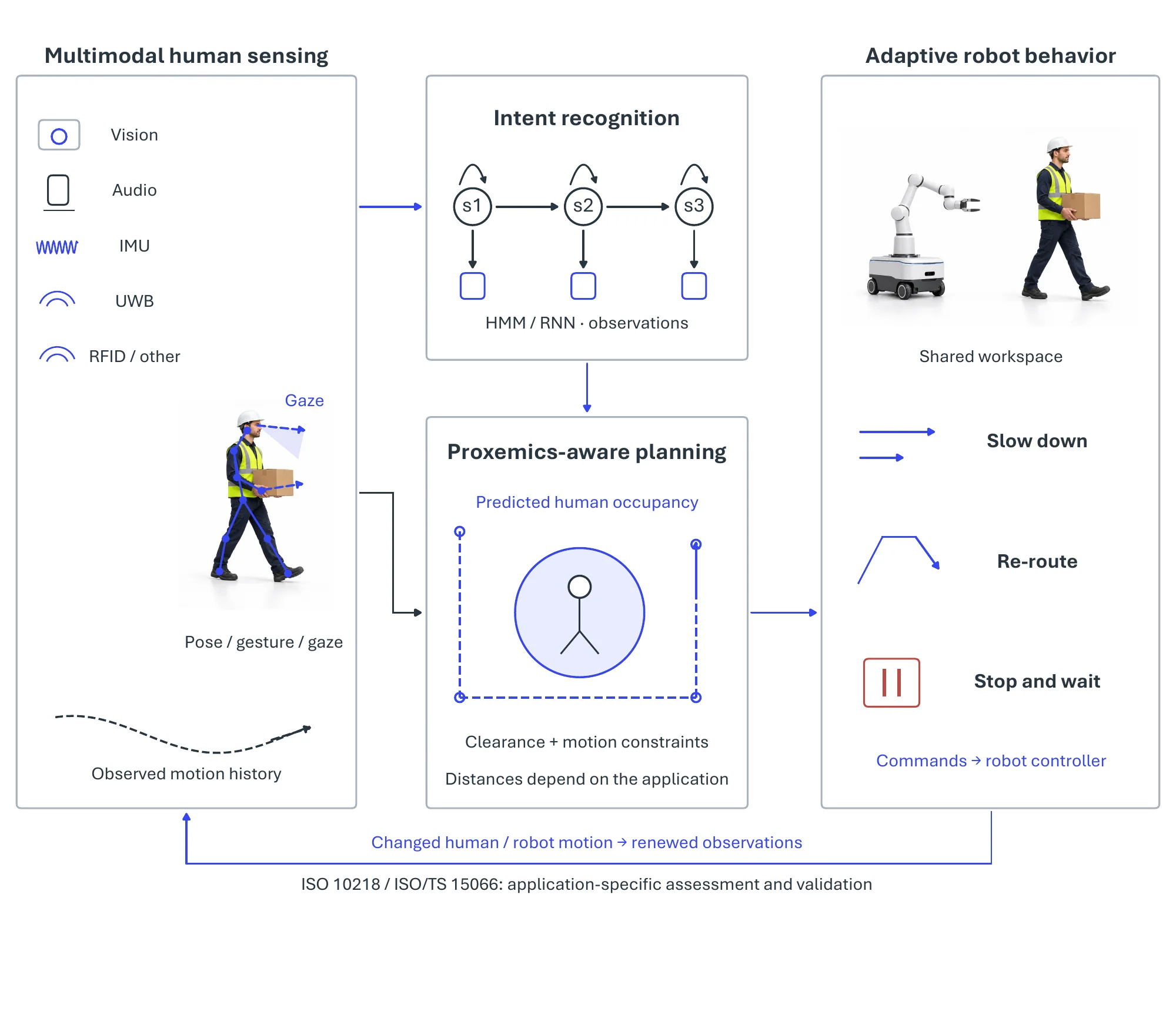
Intent recognition lets robots anticipate human motion: sequence models based on hidden Markov models or recurrent networks predict trajectories and proactively adjust behavior [2638], while proxemics-aware planning maintains socially acceptable distances and re-routes trajectories under human proximity [2639], with multimodal sensing (vision-based detection fused with wearable or RFID localization) improving reliability. These principles are embodied in force- and speed-limited collaborative robots and safety-rated AMRs (see Established Tools and Systems), governed by international standards such as ISO 10218 and ISO/TS 15066. Evaluation combines quantitative safety metrics with qualitative interaction assessment: human-motion corpora such as Human3.6M [550] supply sequences for intent prediction, and key indicators include intervention frequency (safety-triggered stops per hour), near-miss rate, human-detection accuracy, and compliance with ISO-defined safety zones.
| Pivotal task | Benchmark | Representative method | Headline metric |
| Perception (detection) | COCO [440] | YOLO [130] / DETR [415] | mAP |
| Perception (6D pose) | YCB-Video [737] | DenseFusion [740] | ADD |
| Perception (textureless pose) | T-LESS [768] | CosyPose [746] | ADD / VSD |
| Localization & mapping | KITTI [653] | Visual / LiDAR SLAM | APE / RPE |
| Localization & mapping | EuRoC MAV [733] | ORB-SLAM3 [736] (visual-inertial) | APE |
| Mapping (dense) | Replica [339] | RTAB-Map [2629] | IoU / completeness |
| Reasoning & planning | Solomon VRP [2635] | OR-Tools [2634] | total cost / distance |
| Reasoning & planning | OMPL [1272] | Sampling-based planners | planning time / success |
| Manipulation | Amazon Picking [2625] | Integrated perception–grasping team pipelines | pick success / time |
| Manipulation | YCB Object Set [1184] | Dex-Net [336] | grasp success rate |
9.5.8Established Tools and Systems#
The pivotal tasks above are realized in production through a layered ecosystem of simulators, middleware, optimization services, and robot hardware that together constitute the real-world delta over the methods of Part III.
Simulation and middleware form the integration substrate. Digital-twin and physics platforms such as NVIDIA Omniverse Isaac Sim [2327] and Gazebo provide realistic environments for developing and validating perception, localization, and planning pipelines before deployment, while perception SDKs such as NVIDIA Isaac, the Intel RealSense SDK [260], and Zebra RFID/barcode platforms [2640] supply end-to-end sensing support in real facilities. Interoperability across heterogeneous hardware is provided by ROS [2641], ROS 2, and ROS-Industrial, with commercial localization stacks such as SLAMcore2 and BlueBotics ANT3 delivering optimized multi-sensor fusion, map management, and fleet coordination for AGVs and AMRs.
Warehouse management and fleet orchestration sit at the enterprise layer. Large-scale optimization services such as SAP Extended Warehouse Management4, Blue Yonder WMS5, and Manhattan Associates6 integrate task allocation and scheduling with enterprise resource planning, while open toolkits such as Google OR-Tools [2634] and PyMARL support the underlying combinatorial and learning-based planners.
Robot hardware and manipulation close the loop physically. High-throughput pick-and-place arms from ABB7, FANUC8, and KUKA9 are widely deployed and integrated through ROS-based middleware, mobile manipulators such as those from Fetch Robotics10 unify navigation and grasping, and motion-planning frameworks such as MoveIt [2636] and NVIDIA cuMotion provide inverse kinematics and trajectory optimization. For shared workspaces, collaborative robots from Universal Robots11 and AMRs from Locus Robotics12 provide the safety-rated platforms on which the HRC layer is built.
9.5.9Challenges#
Deployed warehouse systems work because they fix the SKU sets, layouts, and operating conditions they handle, and each stage of the pipeline has its own obstacle to relaxing those limits: small-object and cluttered perception, perceptual aliasing in repetitive aisles, multi-agent scalability under uncertainty, manipulation of variable objects, and the safety–throughput trade-off in human–robot collaboration.
Cluttered and Small-Object Perception. Barcode labels and compact SKU packages often occupy only a few pixels in high-resolution images, leading to frequent misdetections, while occlusion and clutter compound the difficulty as items overlap within bins and shelves. A further persistent issue is domain shift: models trained on synthetic or generic data degrade under real-world variation in lighting, reflective surfaces, and packaging. Research responses include domain adaptation and self-supervised learning for generalization [2642], active perception that deliberately adjusts viewpoints or sensing to resolve occlusion [2643], and continual learning that lets perception adapt over time without exhaustive retraining, increasingly combined with multi-sensor fusion and neuro-symbolic representations for higher-level causal and semantic reasoning.
Perceptual Aliasing in Repetitive Environments. Localization and mapping are degraded by dynamic obstacles (humans, forklifts) that generate transient or misleading landmarks corrupting loop-closure hypotheses [2627], and above all by perceptual aliasing: repetitive shelving and low-texture surfaces produce ambiguous place recognition and false data associations in feature-based SLAM [736, 2629]. High-speed AGV and AMR operation further demands low-latency, sub-centimeter pose updates that sensor delays, occlusion, and monocular scale drift can readily violate. Robust multi-modal fusion, learning-based estimation, and tighter integration of SLAM with semantic perception and digital twins are the leading mitigations.
Scalability and Uncertainty in Multi-agent Planning. The combinatorial complexity of multi-robot coordination grows exponentially with the number of agents and tasks, rendering exact optimization intractable for large fleets, while real-world uncertainty (new order arrivals, blocked aisles, unpredictable human movement) necessitates adaptive re-planning and decentralized decision making under partial observability [2631, 2633]. Hierarchical and hybrid planners, graph-neural and differentiable coordination, and simulation-informed multi-objective optimization are the active directions toward scalable, resilient fleet behavior.
Manipulation of Variable and Deformable Objects. Many SKUs exhibit deformable, reflective, or transparent surfaces that interfere with perception and grasp stability [1184, 336], and deformable handling remains especially difficult because grasp dynamics and contact points resist rigid-body modeling [35]. Tactile sensing and force control improve slip detection and grasp robustness but face cost and calibration barriers in industrial deployment, motivating hybrid control that combines analytical models with data-driven adaptation for generalization across geometries and grasp contexts.
Safety–Throughput Trade-off in Collaboration. Robust human detection under occlusion, variable lighting, and cluttered aisles continues to hinder reliable intent estimation [2639, 2638], and the trade-off between throughput and safety remains unresolved: conservative margins reduce efficiency while aggressive planning risks unsafe interaction [2637]. Emerging work emphasizes predictive and explainable safety models that justify decisions in human-interpretable terms, and adaptive safety frameworks that fuse learned intent models with certified control policies for dynamic risk assessment and shared autonomy on the warehouse floor.
- https://www.nvidia.com/en-gb/omniverse/↩
- https://www.slamcore.com/↩
- https://bluebotics.com/↩
- https://www.sap.com/products/scm/extended-warehouse-management.html↩
- https://blueyonder.com/↩
- https://www.manh.com/↩
- https://new.abb.com/products/robotics↩
- https://www.fanuc.com/↩
- https://www.kuka.com/↩
- https://fetchrobotics.com/↩
- https://www.universal-robots.com/↩
- https://locusrobotics.com/↩