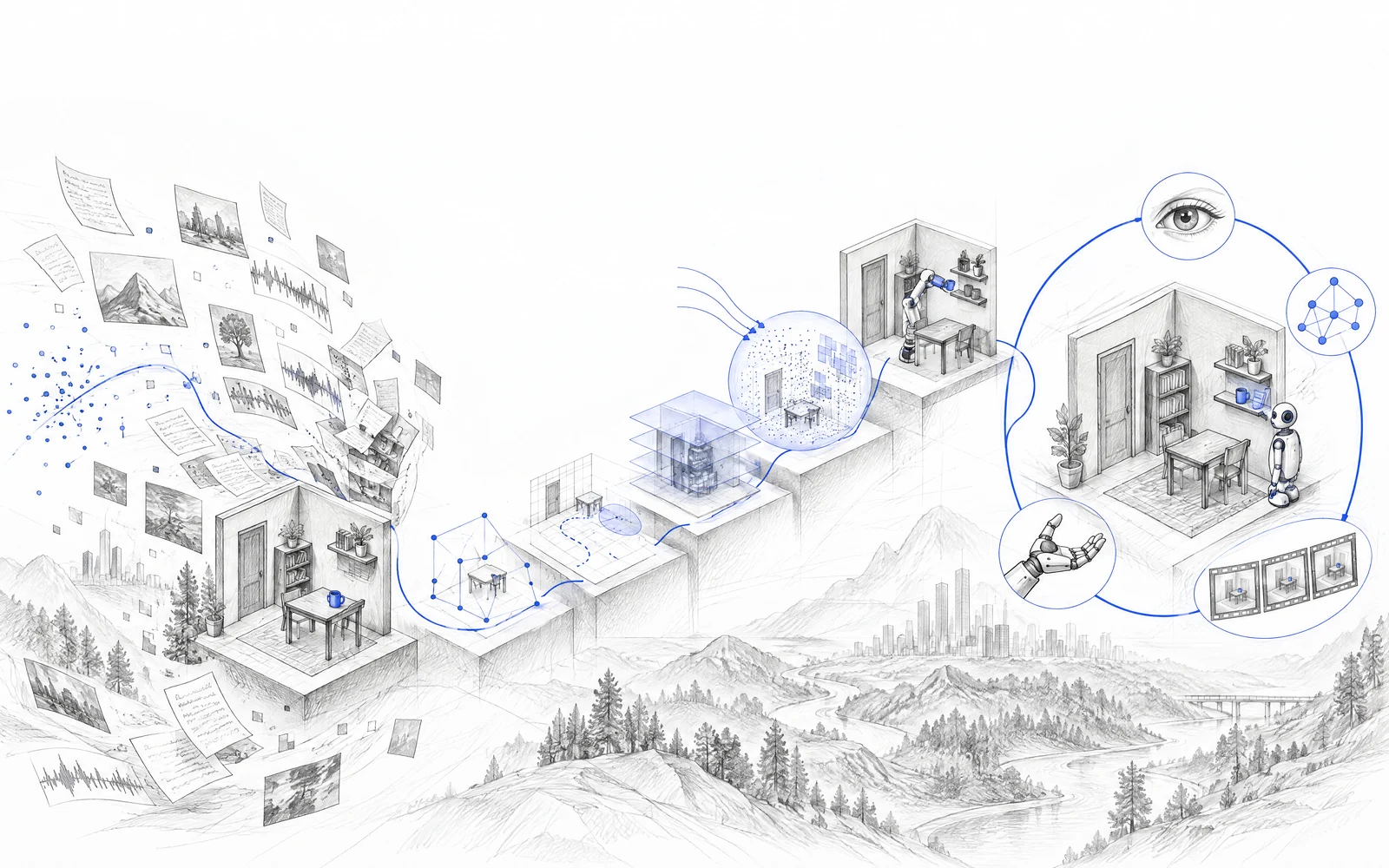
For decades, AI has advanced by mastering well-bounded tasks: recognizing patterns, answering questions, generating outputs from static inputs. Intelligence in the natural world unfolds in space, shaped by structure, constraint, motion, and interaction. As AI systems move from passive prediction to active participation in physical and simulated environments, models trained only on tokens, pixels, or isolated observations struggle to stay coherent across space, time, and action, because they have no explicit notion of where they are, how the world is arranged, or how their interventions change what comes next. Spatial intelligence supplies that notion, and robust, adaptive, and embodied intelligence depends on it. It anchors intelligence in world-centered representations that encode geometry, topology, semantics, dynamics, and affordances, and that let a system perceive beyond its current view, reason about regions it has not seen, predict how a configuration will evolve, and act on it with purpose. Navigation, manipulation, simulation, and long-horizon planning all draw on this one substrate.
This part lays the conceptual ground for treating spatial intelligence as a paradigm. Chapter 1 explains why it is rising now, through four converging shifts in what AI is expected to do, how it learns, the modalities it handles, and the disciplines that study it, and reads the field’s history as five eras, each defined by what it assumed space to be. Chapter 2 reconciles the views of computer vision, robotics, geographic information science, psychology, cognitive science, and linguistics in a working definition, an AI system and its environment coupled through a world-centered representation, and gives it a light formalization. Chapter 3 sets out the research pillars that organize the rest of the handbook.