Foundation model-driven spatial reasoning turns to large pre-trained models (LLMs, vision-language models, vision-language-action models, and large vision models) as the engine of spatial inference. The motivation is empirical: such models display a striking facility with spatial concepts and relations even without task-specific fine-tuning, and a large body of work now recruits them as the core of systems for spatial question answering, planning, and explanation.
What separates these approaches is the locus and granularity at which the foundation model intervenes. At one end the model is the reasoning core itself, answering spatial queries directly (LLM/VLM-centric reasoning) or additionally emitting low-level actions (VLA-based reasoning). Its reasoning can be drawn out step by step, as intermediate deductions in language (chain-of-thought) or as an executable program synthesized from the task (code and DSL generation). It can be coupled to external machinery such as planners, renderers, simulators, and perception modules (tool-augmented reasoning), or grounded in external spatial memory (retrieval- and memory-augmented reasoning). And it can be handed control of a closed interaction loop with the environment (agentic reasoning) or paired with a learned neural simulator of dynamics that serves as the spatial substrate (world-model-based reasoning).
7.3.1LLM/VLM-centric Spatial Reasoning#
Large language and vision-language models have become a default substrate for spatial reasoning, not because they compute geometry explicitly, but because large-scale pretraining leaves them with a usable, if imperfect, prior over how objects are arranged, oriented, and related. This subsection examines that prior directly: what spatial competence text-only LLMs acquire from language alone, how visual grounding sharpens it in VLMs, and where both still fall short of the metric, viewpoint-consistent reasoning that physical tasks demand. The methods are organized by the intervention used to elicit or strengthen this competence, from prompting to architectural change.
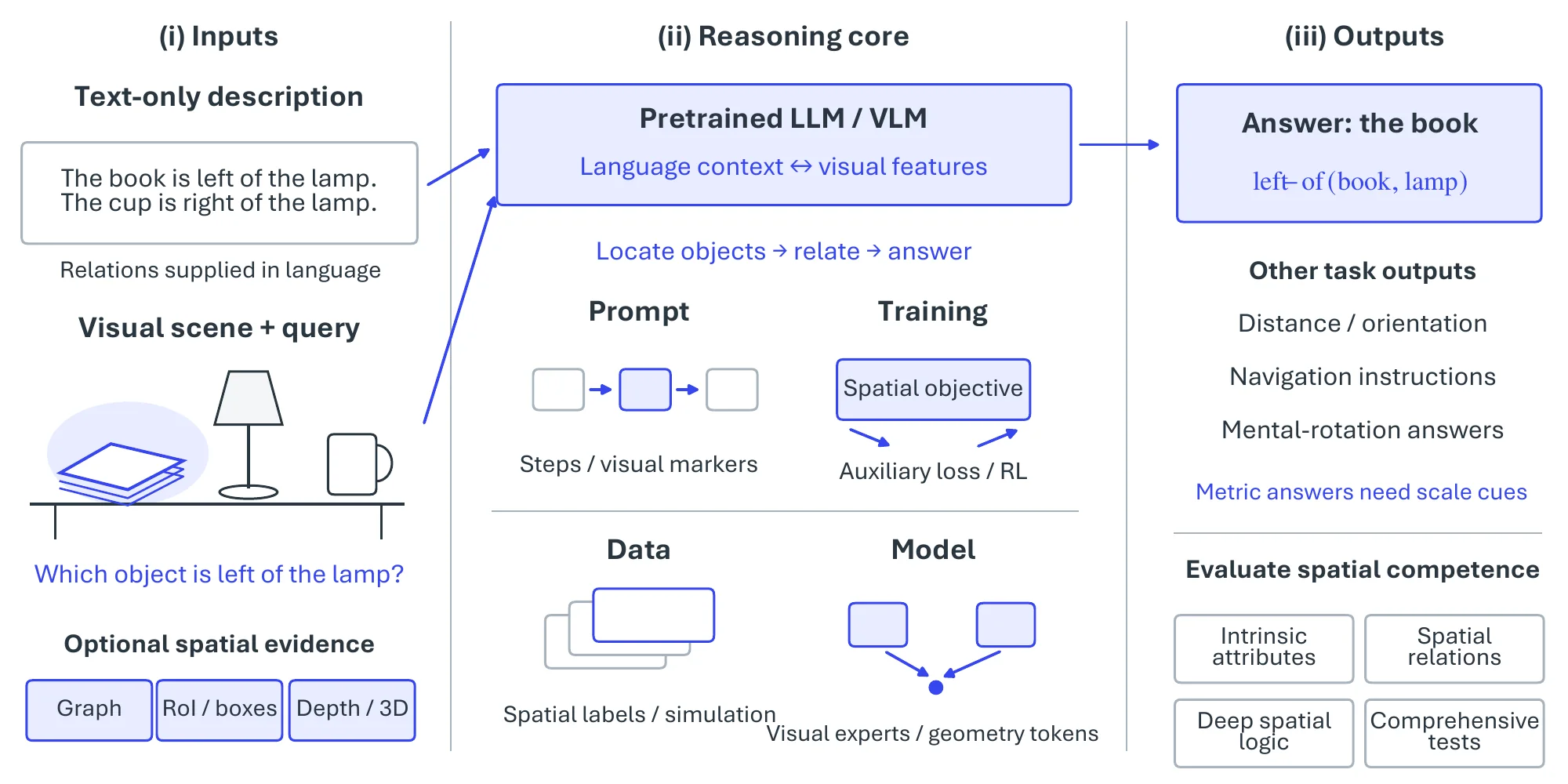
7.3.1.1Task Definition#
Spatial reasoning, which embodied AI [56, 1445], autonomous driving [1446, 790], and spatial content generation [1447, 1448] all depend on, is cast here as inference over learned representations rather than explicit geometric computation: a pre-trained model answers a spatial query from context ,
| (7.36) |
where the context may be absent (a text-only LLM), an image or image set (a VLM), or an image together with auxiliary evidence such as a scene graph, region features, or depth, and the output is a relation, a metric estimate, an orientation, or a navigation plan. For text-only LLMs the spatial prior is built from statistical patterns in massive corpora [15, 1449, 1450]: such models infer that “sky” is above “ground”, but the reasoning is ungrounded, with no mapping to physical reality or visual signal, and therefore prone to physically impossible inferences. VLMs ground the same prior by aligning the LLM with a visual encoder, and spatial competence then extends beyond recognizing objects and their intrinsic attributes to reasoning about relations among objects and to spatial extrapolation, inferring unseen states or running mental simulations from what is perceived [1451, 229].
7.3.1.2Methodology#
Interventions against the spatial deficiencies of foundation models fall into four levels, in increasing order of invasiveness: prompt engineering leaves the model untouched, training strategies update its weights, data-centric augmentation changes what it learns from, and model-centric enhancement alters the architecture.
Prompt Engineering. Prompting elicits latent spatial ability at inference time without weight updates. Textual prompting applies chain-of-thought reasoning [1452] so that the model decomposes a spatial task into intermediate steps (identifying reference objects before deducing relative positions), and inserting scene graphs or coordinates extracted by expert models into the prompt raises accuracy further [1453]. Visual prompting guides attention through markers superimposed on the image itself (masks, coordinate axes, keypoints), and in zero-shot settings such explicit visual cues can outperform fine-tuned models [1454, 1455].
Training Strategies. Contrastive pretraining objectives induce a “bag-of-concepts” behavior that under-supervises spatial structure, so stronger supervisory signals are introduced to enforce spatial alignment. Auxiliary losses such as image reconstruction or coordinate prediction compel the model to attend to pixel-level spatial detail rather than global semantics alone [1456]. Reinforcement learning with spatial reward functions (PPO or GRPO [1457, 1458]; view-consistency rewards [1459]) trains models to perform mental visual simulation or to produce more precise spatial descriptions, moving spatial training from imitation toward preference-based optimization.
Data-Centric Augmentation. Because high-quality spatially annotated data is scarce, augmentation drives much of the progress. Existing 2D/3D datasets are re-annotated with explicit spatial relations, metric distances, or orientations [1460], and simulation engines synthesize data with perfect geometric ground truth, which is especially effective for extrapolation tasks such as mental rotation and path planning where real-world annotation is impractical [1461, 1462].
Model-Centric Enhancement. Architectural changes target the fine-grained visual-spatial features that mainstream encoders miss. Because CLIP-style encoders [143] prioritize global semantics over local geometry, higher-resolution encoders or fused features from multiple visual experts (SAM [138, 482, 1134], DINOv2 [958]) sharpen the perception of shape and position; region-of-interest features or scene graphs supplied as additional input tokens decouple objects from their relationships and tighten fine-grained alignment [1463]; and for 3D reasoning, models ingest point clouds, voxel grids, or depth maps directly [1464] or lift 2D features into implicit 3D representations from multi-view images [1465]. A recent alternative internalizes 3D awareness through auxiliary supervision instead of extra inputs: SpatialSV [1466] forces hidden visual features to predict explicit 3D targets (depth, ray maps, point clouds) during training, injecting geometric priors at no inference cost.
7.3.1.3Benchmarks#
Evaluation has moved from general VQA to benchmarks that probe spatial capability along four levels [1451]. Intrinsic-attribute benchmarks test perceptual precision on single objects, with EgoOrientBench [1467] evaluating object orientation from an egocentric viewpoint and GeoMeter [1468] metric distance and dimension, and they show that even state-of-the-art models are weak at reference-free perception. Relational benchmarks, the most populated class, test the parsing of spatial relations through vision-centric questions such as relative position (CV-Bench [1469], What’s Up [1470]), and this is where general-purpose VLMs peak. Deep-spatial-logic benchmarks go beyond visible relations: SRBench [1471] evaluates mental rotation and navigation, and MindCube [1472] the construction of an internal 3D mental model from multiple views. Comprehensive suites such as RealWorldQA [1473] and OmniSpatial [1474] cover all levels at once; a wider coverage map of these static probes appears in Table 7.5 of §7.3.7.
7.3.1.4Challenges and Trends#
Three obstacles limit what foundation models can be made to do spatially. Mainstream vision encoders such as CLIP optimize for global semantic alignment and capture coarse semantics at the expense of fine-grained geometric detail [1475, 1476], and the contrastive objective compounds this by inducing the “bag-of-concepts” behavior that under-supervises structural relations among objects [1477, 1478]. Training data with precise metric annotation (quantitative distance, 3D coordinates) is scarce, and existing datasets rarely support the extrapolation tasks that require reasoning beyond direct observation [1479, 1480]. Spatial reference is ambiguous: “to the left” may mean the viewer’s left (egocentric), the object’s left (allocentric), or another agent’s left, and VLMs seldom switch frame of reference from context, which misaligns interpretation in embodied use [1479, 1481].
Two directions respond to these. Reinforcement learning with process rewards such as GRPO moves training from static VQA toward interaction, letting the model acquire spatial logic by trial and error in simulation or the real world [1457]. World-model-informed pretraining attacks the 2D-to-3D gap directly, learning physical regularities (gravity, collision) alongside image-text correspondence from synthetic corpora with exact geometric ground truth [202, 1461, 229]; the use of such world models at inference time is the subject of §7.3.8.
7.3.2VLA-based Spatial Reasoning#
Vision-language-action (VLA) models push spatial reasoning past description and into execution: the same latent competence that lets a model answer where an object sits must now drive an end effector toward it without violating depth, contact, or stability constraints. Spatial reasoning here is therefore inseparable from the agent’s body and the physics of its workspace, and a plan that reads correctly on paper still fails if it ignores reachability or collision. The methods below are organized by their action-generation paradigm (autoregressive, diffusion-based, reinforcement-learning-driven, and hybrid).
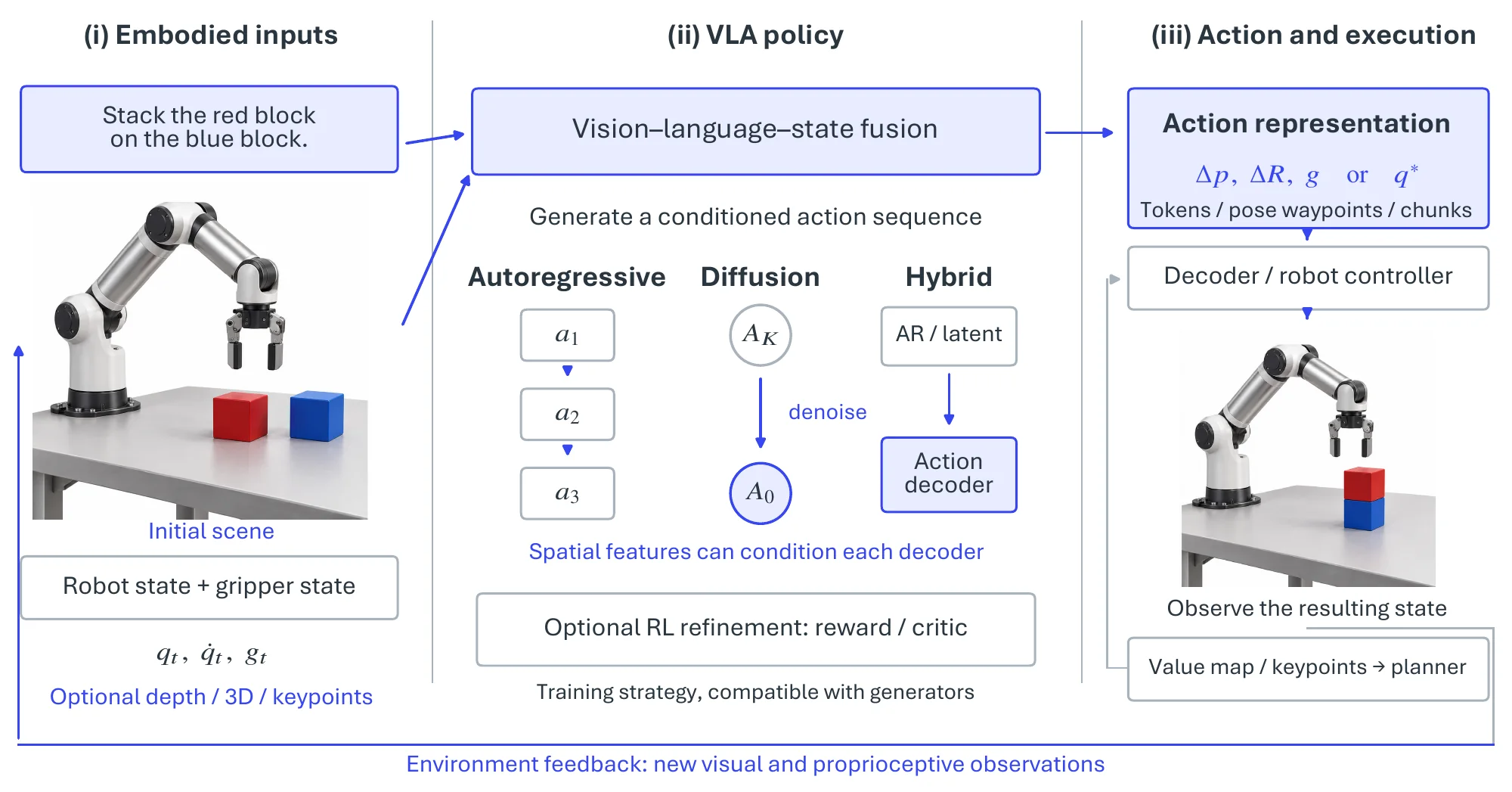
7.3.2.1Task Definition#
A VLA model extends the reasoning core of §7.3.1 with an action head: given a visual observation , a language instruction , and the robot’s proprioceptive state , it emits an executable action chunk
| (7.37) |
where each action encodes end-effector increments, gripper commands, joint targets, or pose waypoints that a controller converts into motion [1482, 1483]. Spatial reasoning under this paradigm is embodied grounding: language tokens must be anchored not only to visual features but to the three-dimensional geometry, affordances, and constraints of the workspace, so that the generated actions respect depth, stability, and contact rather than merely naming where objects are.
7.3.2.2Methodology#
VLA methods for spatial reasoning fall into four classes by their action-generation and reasoning paradigm.
Autoregression-Based Methods. Autoregressive methods cast spatial manipulation as next-token prediction over a unified token stream of discrete action tokens. Gato [149] showed that heterogeneous modalities can be jointly tokenized and trained in one autoregressive model; PointVLA [1484] injects point-cloud representations into a pretrained VLA for lightweight 3D reasoning without redesigning the architecture; and TraceVLA [1485] adds visual trace prompting, explicit spatiotemporal cues that improve long-horizon spatial awareness and task consistency during generation.
Diffusion-Based Methods. Diffusion methods model action generation as conditional denoising, which suits trajectories that must respect physical constraints and uncertainty. SE(3)-DiffusionFields [1486] runs the diffusion process in pose space and jointly optimizes grasping and motion planning; 3D Diffuser Actor [1487] conditions the denoiser on structured 3D scene representations so that manipulation trajectories stay geometrically consistent; and ForceVLA [1488] brings force and tactile feedback in through a mixture-of-experts design for contact-rich manipulation.
Reinforcement Learning-Driven Methods. Reinforcement learning refines VLA policies through interaction with the environment, particularly on long-horizon tasks (the broader treatment of RL with spatial inductive biases is §7.2.5). VIP [1489] learns a goal-conditioned, action-independent value function that implicitly encodes spatial distance to assess task progress; NaVILA [1490] couples VLA representations with RL policies so that quadruped robots navigate and avoid dynamic obstacles on difficult terrain; and SafeVLA [1491] adds safety critics that constrain high-risk behavior during manipulation.
Hybrid Architectures. Hybrids combine generative mechanisms and add explicit spatial representations to strengthen 3D reasoning. 3D-VLA [201] joins autoregressive language modeling with diffusion-based action prediction inside a generative 3D world model; VoxPoser [1492] has an LLM compose 3D voxel value maps, separating goal interpretation from geometric planning; ReKep [1493] models spatiotemporal dependencies as relational keypoint constraints for precise manipulation; and RoboPoint [1494] predicts affordance maps that encode where actions are feasible, as a prior for downstream planning and control.
7.3.2.3Benchmarks#
Evaluation rests on two complementary resources: generalization-oriented benchmarks in simulation and large-scale real-world embodied datasets. VIMA-Bench [1495] measures spatial generalization through a four-level protocol that runs from random object placement to fully novel task compositions; ALFRED [1307] poses long-horizon household tasks that combine high-level goals with low-level instructions; and CALVIN [1496] and LOTA-Bench [1497] test language-conditioned manipulation across environments, scoring generalization to unseen objects and configurations. Among datasets, Open X-Embodiment [1498] is the most comprehensive, integrating 22 robot datasets from 21 institutions and 527 skills to enable cross-platform generalization; BridgeData [1499] spans 71 tasks in 10 environments and shows that joint training on limited out-of-domain data raises success rates substantially; and RH20T [1500] adds vision, force, and audio across 147 tasks, suited to one-shot learning and experience-based policy transfer. Across these suites performance falls sharply along every generalization axis (L1 to L4 in VIMA-Bench, seen to unseen splits in ALFRED, single to multi-step chains in CALVIN), while data scale and embodiment diversity are the most reliable lever for cross-platform transfer and multimodal sensing (force, audio) becomes decisive where vision alone underdetermines the contact configuration.
7.3.2.4Challenges and Trends#
The generalization drop above reflects a semantic–physical misalignment: VLA systems inherit their competence from LLMs and VLMs that excel at semantic abstraction and cross-modal alignment but have had little exposure to physical interaction, so instructions are often interpreted correctly and executed incorrectly. The same gap appears as pseudo-interaction: actions are generated from statistical co-occurrence in the training data rather than from an understanding of environment dynamics or causality, so when the environment is unfamiliar or changes quickly the model cannot revise its strategy from sensory feedback.
Two further limits are practical. Long-horizon consistency is unsolved for autoregressive and diffusion policies alike: over extended action sequences the spatial representation drifts or hallucinates, and existing embodied datasets, including Open X-Embodiment, are dominated by tabletop manipulation and grasping, so environmental diversity and large unstructured scenes are under-represented. Inference latency compounds across autoregressive decoding of large Transformers, and for high-frequency tasks such as dynamic grasping or mobile navigation the compute and memory demands remain prohibitive on embedded platforms.
The directions that follow are a unified token stream over vision, language, and action that lets VLA systems grow into proto world models (the world-model view is developed in §7.3.8); active perception and causal reasoning, in which the agent probes its environment and updates its policy from feedback, as the answer to pseudo-interaction; and virtual-real data synthesis (high-fidelity simulation, synthetic generation, multi-robot data sharing) as the route to embodied data at the scale that text corpora provided for language models.
7.3.3Chain-of-Thought for Spatial Reasoning#
Spatial reasoning poses unique challenges for large language models (LLMs), as it requires the manipulation of geometric relations, perspective-taking, and dynamic transformations: skills that are not purely symbolic but grounded in embodied cognition. Chain-of-Thought (CoT) prompting [78], originally developed as a mechanism to elicit intermediate reasoning steps in arithmetic and commonsense tasks, has therefore been imported into spatial reasoning not as a generic recipe for longer answers, but as a way to externalize the intermediate spatial commitments that a model must keep consistent: which object is left of which, which frame of reference is active, which action changes the scene, and which hypothesized 3D configuration explains the observation. The evidence is mixed. In some settings, explicit rationales help decompose a spatial query into auditable subgoals; in others, they induce a fluent but ungrounded verbal trace that makes spatial performance worse [1501].
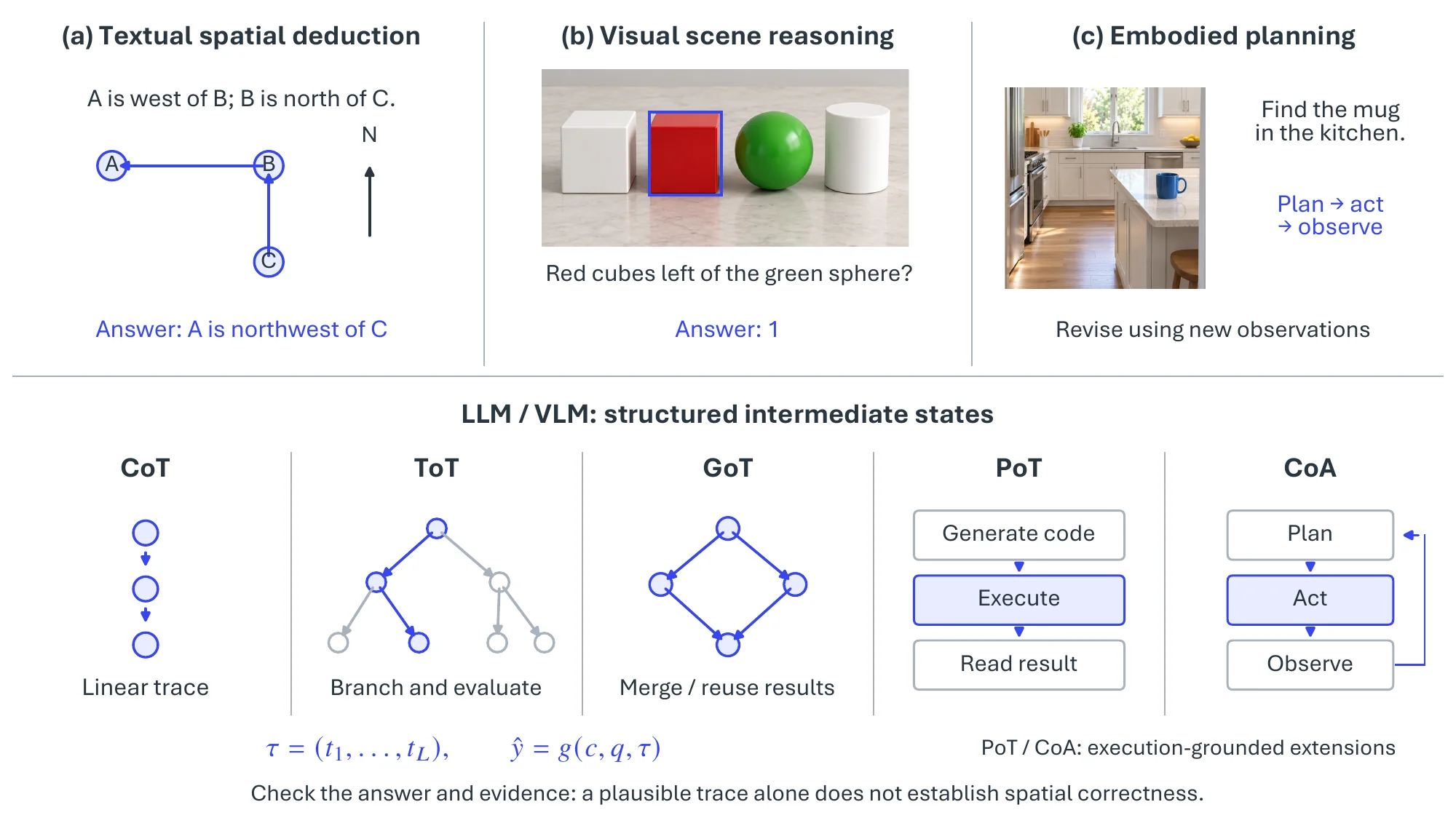
7.3.3.1Task Definition#
The task is to answer a spatial query about a scene or environment, given context that may be purely textual, visual, 3D, temporal, or embodied. A CoT-style reasoner augments the answer with an intermediate trace
| (7.38) |
where each records a partial spatial commitment: a relation, coordinate estimate, subgoal, viewpoint change, object binding, or predicted action effect. The trace is useful only insofar as it improves the grounded answer or makes the failure mode inspectable; many apparent “reasoning steps” are not grounded in metric or perceptual evidence and merely rationalize a final guess, so the central question is not whether a model can produce more text, but whether the trace helps preserve spatial invariants across transformations, viewpoints, time steps, and actions.
7.3.3.2Methodology#
CoT, Tree-of-Thought (ToT) [1502], and Graph-of-Thought (GoT) [1503] differ mainly in the topology of the intermediate trace: CoT is a single path through partial spatial commitments; ToT branches over alternative hypotheses or subplans and uses a value function to prune; GoT allows shared sub-derivations, such as reusing a computed room layout or object graph across several queried relations. All three search over partial reasoning states with a proposal mechanism, an evaluator , and a halting rule ,
| (7.39) |
and differ in whether the search structure is a path, a tree of alternatives, or a graph of reusable sub-results, and in whether the trace stays verbal or becomes executable through programs (Program-of-Thought, PoT [1504]) or environment-changing actions (Chain-of-Action, CoA [1505]). The use cases below organize how these traces are deployed.
Text-Only Spatial Deduction. In linguistic spatial puzzles, route descriptions, and relative-position QA, the model must maintain a latent arrangement without visual feedback. CoT can expose intermediate bindings (e.g., , “A is north of B; C is west of A”) and reduce one-shot relational confusion [1506], while ToT-style branching can preserve competing layouts until enough constraints have been applied. The persistent failure mode is coordinate drift: even with explicit steps, LLMs lose track of the origin, orientation, or accumulated displacement in textual mazes and grid-navigation tasks [1507], so text-only CoT is most reliable when the trace is tied to a compact symbolic artifact (a table, coordinate sketch, or adjacency list) rather than to unconstrained prose.
Multimodal Scene Reasoning. In image- or video-grounded QA, a CoT trace must bind language to perceptual evidence: which object instance is referred to, what relation is visible, which is occluded, and which viewpoint assumption is made. Free-form rationales can verbalize a relation that the image does not support, so recent work moves toward grounded intermediate artifacts (structured layouts, object bindings, diagrams, or executable module calls): SCoT-style planners use layout-coordinate traces to guide diffusion models on the generation side [1508], and program-mediated systems call perception modules rather than describe them [1509], the paradigm of §7.3.4. Here ToT and GoT serve less as generic search algorithms than as hypothesis-management devices that let a model compare object correspondences, camera frames, or depth-order explanations before committing to an answer.
Embodied Planning and VLA Reasoning. In navigation, manipulation, and vision-language-action tasks, spatial reasoning unfolds over time, and the trace must connect perceptual state, subgoal choice, action feasibility, and feedback from the environment. CoT-style subgoals support long-horizon planning in navigation [1510, 1511], embodied instruction following [1512, 1513], and VLA models that expose intermediate visual or action commitments: CoT-VLA pairs reasoning with predicted visual states [1514], ACoT-VLA formulates the trace in action space through coarse action intents and reference trajectories [1515], and scene graphs stabilize the trace by giving the model a persistent substrate for object identities and relations [1516].
7.3.3.3Benchmarks#
Evaluation mirrors the three use cases. Spatial puzzles, relative-position QA, and textual maze navigation are evaluated with prompt-based CoT on the suites of [1506, 1507]; visual question answering and scene-grounded compositional queries are evaluated under CoT with program execution (§7.3.4), where the rationale’s correctness is mediated by program output rather than by the rationale string; and long-horizon planning with sensory feedback is evaluated through CoT-augmented navigation (NavCoT [1510], NavR1 [1511]), CoT-augmented instruction following (ThinkBot [1512], EmbodiedGPT [1513]), visual- and action-trace supervision for VLA models [1514, 1515], and scene-graph-augmented embodied reasoning [1516].
7.3.3.4Challenges and Trends#
The transfer of CoT to spatial intelligence is uneven. Coordinate hallucination persists under simple textual CoT: even with ToT-style beam expansion, prompt-based planners mistrack absolute positions across multi-step chains in maze and grid-navigation problems [1507]. Ungrounded supervision can make things worse: textual CoT applied without a structured or rationale-grounded training signal degrades spatial VLM performance, because the model is forced to verbalize a reasoning trace it does not possess [1517, 1501], especially when the prompt rewards plausible explanation length over geometric correctness. Search cost scales super-linearly in solution depth for ToT and GoT (and in the branching factor for ToT), which limits real-time or on-device deployment. Trace–action mismatch arises in embodied settings when a VLA model produces a coherent verbal rationale while its action head follows a different latent policy; action-aware CoT aligns rationales with action tokens and visual predictions [1515], but reliable attribution between the visible trace and the executed behavior remains unresolved.
Grounded rationale supervision pairs CoT with explicit spatial signals (scene graphs [1516], depth maps, 3D coordinate frames, action traces, or layout-coordinate traces for spatial generation [1508]) so the rationale is verifiable rather than free-form. A complementary line makes the trace execution-grounded: PoT-style traces compile and run against a geometric engine or vision–language tool, with execution outputs serving as a truth signal, the natural bridge from CoT to code / DSL generation in §7.3.4; for embodied agents the parallel bridge runs from CoT to CoA and the agentic orchestration loops of §7.3.7.
7.3.4Code/DSL Generation for Spatial Reasoning#
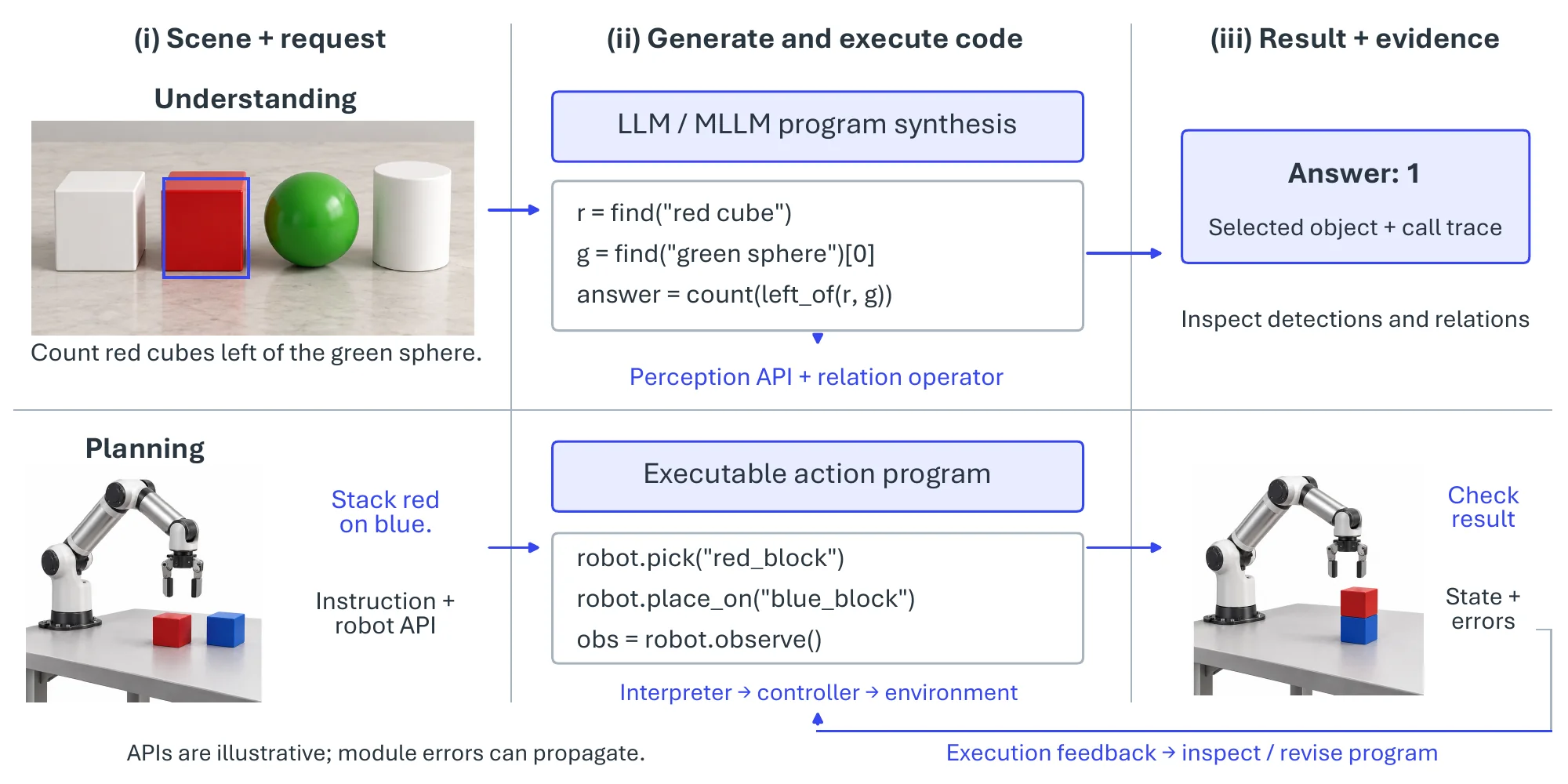
Code/DSL generation treats spatial reasoning as program synthesis: an LLM or MLLM translates a natural-language task into an executable program, and a more deterministic system (a robot control API, a physics simulator, a library of vision functions) executes it. Relative to the explicit structured reasoners of §7.2.2, the specialized parser and fixed module set are replaced by the world knowledge and reasoning ability of the LLM, so the operation set is no longer confined to a predefined vocabulary; relative to the chain-of-thought traces of §7.3.3, the trace is a program whose execution against an external environment supplies a truth signal that a free-form rationale cannot. Figure 7.24 shows the two operating modes.
7.3.4.1Task Definition#
Given a high-level, often ambiguous, natural-language query and access to an API (a robot’s control interface, a programming-language interpreter, or a set of vision-language functions), the LLM acts as a high-level planner that emits a program and offloads execution to the external system ,
| (7.40) |
where is written in a general-purpose language such as Python or in a domain-specific language and composed of calls that manipulate objects, query spatial relations, or control an agent, and the output is a change in the environment’s state (a robot moving an object), an answer to the query, or both.
7.3.4.2Methodology#
Code/DSL for Understanding. For static scenes the LLM generates code that dissects a visual query by composing calls to perception modules, so the program is itself an explicit, verifiable reasoning chain. VisProg [1365] prompts an LLM to produce a program in a high-level DSL that sequentially invokes modules for image understanding, image manipulation, and knowledge retrieval, implemented either heuristically in Python or by neural models such as OWL-ViT [422] and Stable Diffusion [185]. ViperGPT [1131] instead exposes two classes, ImagePatch and VideoSegment, whose methods (find, exists, compute_depth, verify_property) each call a pretrained model, and generates a Python script that chains these calls to answer a complex query about an image or video, composing existing vision tools zero-shot. Both depend on a static, human-defined DSL; VADAR [1518] removes that limit by synthesizing the API implementations dynamically, in an API-generation stage followed by program synthesis, and LEFT [348] makes the approach learnable by having the LLM generate differentiable logic programs that chain trainable perception networks, so concept grounding can be learned where no pretrained module exists. The same recipe lifts to 3D: LLM-Grounder [1519] decomposes a grounding query into Python code that calls 3D grounding tools such as OpenScene [39] or LERF [369] to locate objects in a scene.
Code/DSL for Planning. Beyond static understanding, the generated code can serve as a policy that acts in an environment, with the LLM as high-level planner and the interpreter handling deterministic low-level execution. Code as Policies [1366] has the LLM write Python that calls a robot’s control API, so that “put the apple in the bowl” becomes robot.pick(’apple’) followed by robot.place(’bowl’), with implicit steps and preconditions supplied by the model’s common sense. In simulation, Voyager [150] explores Minecraft by writing, executing, and refining its own code: it prompts the LLM for code to achieve a goal, receives environment feedback (success, failure, new inventory items), debugs accordingly, and adds successful routines to a growing library of reusable skills.
7.3.4.3Benchmarks#
Code/DSL generation for spatial reasoning is typically evaluated under three benchmark families that mirror the two-mode split of the §Methodology above. For 2D scene understanding, methods are evaluated on compositional visual question answering (GQA [839]), referring expression comprehension (RefCOCO / RefCOCO+ / RefCOCOg [1082, 1083, 1088]), and image-editing benchmarks. For 3D scene understanding, evaluation has converged on 3D referring expression and 3D visual grounding benchmarks (e.g., , ScanRefer [373], Multi3DRefer [1107], ScanQA [41]), which exercise both the perception-API composition and the long-tail of object-attribute reasoning. For embodied planning, the canonical evaluation suites are ALFWorld [1520] and VirtualHome [1521] (long-horizon household tasks) and Minecraft (open-world goal acquisition, as exemplified by Voyager [150]); the headline metric in this family is task-success rate over multi-step goals rather than single-step accuracy. Across all three families, the recurring methodological observation is that code-generation methods inherit the accuracy of their underlying perception or control modules, so benchmark performance tracks the module suite more tightly than it tracks the LLM backbone.
7.3.4.4Challenges and Trends#
The interpretable trace comes with three recurring limits. A fixed, human-authored DSL (ViperGPT’s find / compute_depth / verify_property) restricts the model to a predefined operation set, so spatial concepts outside the API are systematically out of reach; VADAR’s dynamic API synthesis [1518] is a response but does not solve the coverage problem. Brittle execution with silent failure follows from the dependence on perceptual modules (OWL-ViT [422], OpenScene [39], LERF [369]): an upstream error propagates through the program and yields a plausible but wrong answer with no diagnostic signal. Sample-inefficient debug loops limit self-refinement agents such as Voyager [150] and Code as Policies [1366], whose LLM calls per task scale poorly in high-dimensional or stochastic environments.
Two directions follow. PoT-style execution-grounded rationales are being folded back into chain-of-thought training, with the generated program serving as both rationale and verification signal, and learnable DSLs such as LEFT [348] replace fixed perception with differentiable logic programs whose components are trainable, pointing toward a DSL that adapts under task supervision rather than being hand-engineered.
7.3.5Tool-augmented Reasoning#
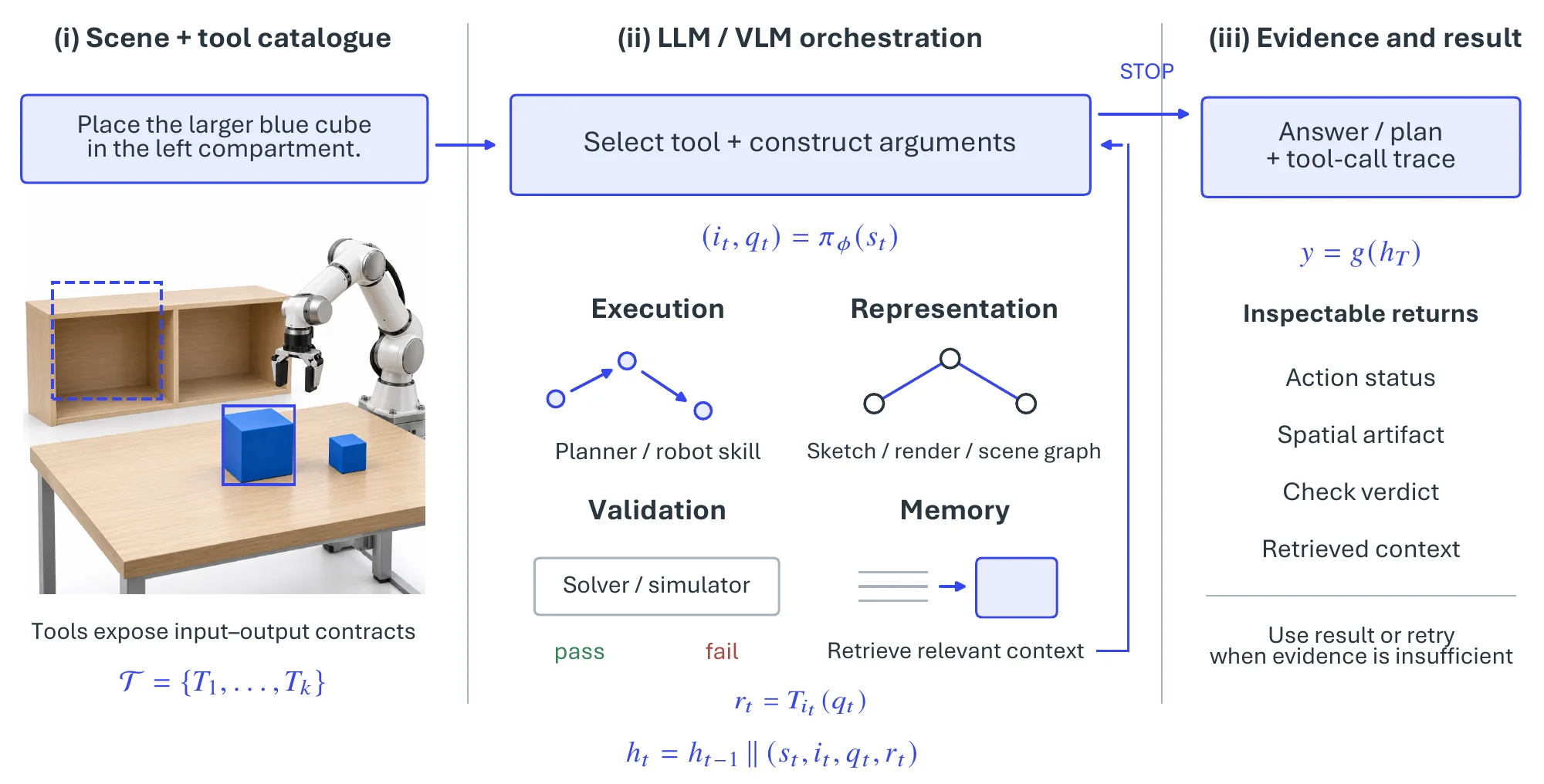
Tool-augmented reasoning in spatial intelligence is the paradigm in which an LLM or VLM acts not as an isolated solver but as an orchestrator over a catalogue of external operators. These operators may be planners, renderers, CAD systems, physics simulators, retrieval engines, perception modules, or metric estimators. The section boundary is deliberately operational: tools are treated as black boxes with input–output contracts, and the central research problem is the orchestration policy that decides when to call them, how to parameterize the call, and how much to trust the returned result. When the executable program itself becomes the reasoning trace, the detailed treatment belongs to code / DSL generation (§7.3.4); when persistent external memory becomes the learned object, it belongs to retrieval- and memory-augmented reasoning (§7.3.6); when the loop becomes closed-loop control, it becomes agentic spatial reasoning (§7.3.7); and when the tool is a learned predictive simulator, the specialized discussion is world-model-based reasoning (§7.3.8).
7.3.5.1Task Definition#
A tool-augmented reasoning system is formally defined as a tuple , where denotes the reasoning core, is a catalogue of external tools, and each tool is exposed only through a structured input–output interface. The orchestration policy governs tool selection, argument construction, response parsing, retry / fallback behavior, and feedback integration. Given an input , the system maintains a time-ordered reasoning history (initially ) and proceeds by the iterative update
| (7.41) | ||||||
where is the intermediate reasoning state, is the selected tool-and-query pair, is the returned result, and denotes appending to the interaction history. The loop halts when the policy or model emits a STOP decision, after which an output decoder produces the final answer . Both the reasoning core and the tool internals are black-box; what is exposed, optimized, and evaluated is the interface history and the policy that controls it.
7.3.5.2Methodology#
Two design choices interact: the tool catalogue determines which black-box capabilities are available, and the orchestration policy determines how they are sequenced, checked, and folded back into the model’s spatial answer. The catalogue roles below are complementary, not sequential.
Execution-Augmented Reasoning. Execution tools bridge the semantic–geometric gap between high-level language and low-level feasible action [1522]: they expose callable primitives such as motion planners, robot skills, affordance estimators, navigation controllers, or simulator actions, and the orchestrator translates a spatial intention into a sequence of calls, monitors whether the result satisfies the goal, and recovers when a tool fails. Representative systems include affordance-grounded planning, where language-model outputs are modulated by value functions for skill feasibility [1311]; API- or code-mediated manipulation, where perception and control primitives are composed through generated calls [1366, 1492]; and action-token models that fold robot actions into the model vocabulary [1523, 97, 56]. SpatialClaw [1524] studies the action interface itself: a stateful Python kernel pre-loaded with perception and geometry primitives lets the agent execute one analysis step, observe intermediate outputs, and adapt the next call rather than committing to a full static program. Closed-loop feedback and hierarchical decomposition [1525, 1526, 1527, 1528, 1529] push this family toward agentic orchestration.
Representation-Augmented Reasoning. Representation tools externalize spatial working memory through sketches, 3D renders, CAD systems, scene graphs, game engines, or visualization buffers, motivated by the observation that transformers struggle to manipulate fine-grained geometry internally [1530]. Externalization reduces hallucination by moving spatial computation out of parametric memory [1530] and enables iterative self-correction through visual feedback loops [1457]; the claim is that spatial reasoning improves when models can see what they think, as in Vision-Augmented Prompting [1531], which interleaves image synthesis with chain-of-thought so that textual and visual reasoning can be reconciled. Recent spatial-tool agents make the evidence acquisition active: PERIA [1532] pairs perception tools that expose symbolic or spatial evidence with interaction tools that manipulate the visual context, learning multi-tool behavior from synthesized trajectories and reinforcement learning, and S-Agent [1533] casts the VLM as a semantic planner over a hierarchy of spatial tools that lift 2D object evidence into 3D geometric support while accumulating scene and agent memory across multi-view images or video.
Validation-Augmented Reasoning. Validation tools check whether intermediate outputs are logically, causally, geometrically, or physically consistent: the orchestrator translates a candidate answer or plan into a verifiable representation and queries a planner, solver, judge, or simulator. Generated spatial plans can be encoded as constraint-satisfaction problems or PDDL specifications and validated by symbolic planners or SMT solvers [1534, 22, 1535], which checks preconditions, geometric relations, and causal effects; physics simulators such as MuJoCo [1187] and Isaac Sim1 act as physical oracles for the feasibility of proposed movements, collisions, and trajectories [1536, 1492, 229]; neuro-symbolic systems integrate Answer Set Programming solvers that translate natural language into formally verifiable logical rules for relational and topological coherence [1537, 1538]; and plan-critic mechanisms [1539, 1540] or an LLM-as-a-Judge that evaluates and refines the plans of a primary planner close a self-correcting loop [1541].
Memory-Augmented Reasoning. Memory tools expose external storage and retrieval through a black-box query interface: the orchestrator asks for relevant prior observations, spatial subgraphs, object histories, or task episodes and decides how to incorporate what is returned, which addresses the “crisis of context” in long-horizon robotic tasks whose sensory streams exceed the finite context window of an LLM. At this level the memory may be a hierarchical cognitive architecture such as RoboMemory or an open-vocabulary 3D scene graph such as ConceptGraphs (both treated in §7.3.6), a classical 3D or dynamic scene graph [341, 1542], or a system-level memory manager: MemOS [1543] introduces paging and scheduling that swap spatial contexts in and out of the reasoning core, treating the LLM as a CPU and the tool as RAM, and spatio-temporal retrieval engines such as ReMEmbR [1544] and MemoTime [1545] index video history in vector databases so that an agent can answer “where did I leave the keys five minutes ago?”.
Predictive Tools and World-Model Feedback. Some catalogues include tools that simulate counterfactual or future spatial states rather than observe or verify the present one: generative video models, learned dynamics models, and predictive latent models are called as expensive but powerful instruments for “what would happen if” or “what would this look like from another viewpoint” [1536, 1546]. Here they are one class of callable tool; their feedback forms, imagination cost, and fidelity are the subject of §7.3.8.
7.3.5.3Benchmarks#
Evaluation asks whether the orchestrator selects useful tools and converts their outputs into better spatial decisions. For execution-augmented tool use the canonical suites are SayCan [1311] (LLM-grounded household manipulation), ALFWorld [1520] and VirtualHome [1521] (long-horizon text-and-embodied environments), and Voyager-on-Minecraft [150] (open-world skill accretion through code-as-policy). For spatial-reasoning-specific tool use, SpaceTools [1547] targets the metric gap between VLM perception and physical manipulation, and Cambrian-S [1546] introduces the spatial-supersensing framework that exercises tool augmentation from perception (Stage I) to predictive world modeling (Stage IV). Validation- and memory-augmented reasoning are evaluated on the memory and agentic benchmarks of §7.3.6 and §7.3.7, and predictive tools on those of §7.3.8, where the central question is whether imagined evidence improves the final answer enough to justify its cost.
7.3.5.4Challenges and Trends#
The recurring limitations originate in the LLM–tool interface rather than in any individual tool. The exploration bottleneck is combinatorial: each tool adds an action dimension and tool composition multiplies them, so naive reinforcement learning over tool use is inefficient; Double Interactive Reinforcement Learning (DIRL) [1547] warm-starts from expert demonstrations before open exploration, but the scaling of the action space itself is unresolved. The metric gap moves rather than disappears: VLMs excel at semantic perception but fail at the precise metric estimation manipulation requires, and offloading geometry to depth estimators and pose solvers lets the LLM reason over measurements instead of hallucinations [1547, 1522], yet query formulation, output parsing, and error attribution at the interface become the new precision bottleneck. Interface calibration compounds this: tool outputs arrive with heterogeneous units, confidence scores, coordinate frames, and failure modes, and an orchestrator that cannot judge whether a returned depth map, solver result, retrieved memory, or imagined rollout is trustworthy can perform worse than a direct model response.
Learned orchestration is one direction: policies are moving from hand-written call rules toward imitation- or reinforcement-learned controllers that decide which tool is worth its latency and uncertainty budget [1547]. A parallel shift is the System-1 / System-2 architectural split, in which the neural backbone handles fast, intuitive perception (System 1) while the toolset handles slow, deliberative, verifiable reasoning (System 2) [1548], achieving both flexibility and rigor.
7.3.6Retrieval- & Memory-augmented Spatial Reasoning#
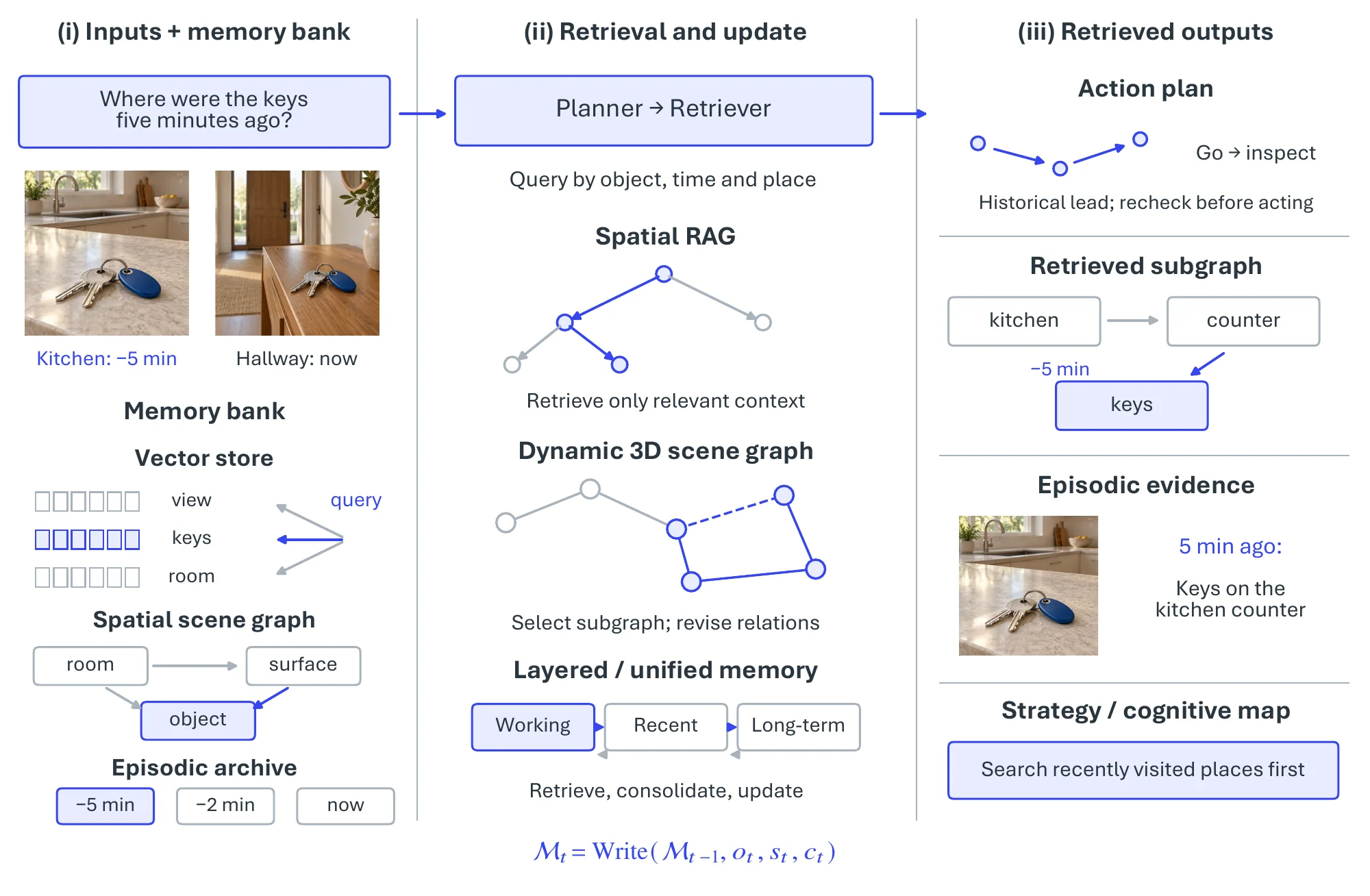
Retrieval- and memory-augmented spatial reasoning is best understood through a Planner-Memory-Retriever decomposition. The Planner decides what spatial information is needed for the current instruction; the Memory Bank stores an external, updateable state of the world; and the Retriever selects the subset of that memory that should condition the next reasoning or action step. Unlike one-shot retrieval-augmented generation, spatial memory must also support write and update: an agent may discover that a door is blocked, that an object has moved, or that a previous topological belief was wrong, and the memory state must change accordingly.
The memory bank is therefore not merely a text corpus. In spatial domains, may contain vector embeddings of views and instructions, metric maps and voxel belief states, dynamic 3D scene graphs, frontier snapshots, past trajectories, user preferences, and brain-inspired episodic archives. The central problem is to make these heterogeneous memories queryable: semantic retrieval must locate relevant objects and events, while geometric retrieval must preserve relations such as containment, support, reachability, and path connectivity.
7.3.6.1Task Definition#
Where §7.3.5 treats memory as one black-box tool among others, here the external memory itself is the central learning target. Formally, a retrieval- & memory-augmented system is the triple , where is a reasoning core (an LLM, VLM, or embodied planner), is an external memory store, and maps a query and the current memory state to a relevant context fragment . Given an instruction , an observation stream , and a reasoning history (initially ), the system proceeds by the iterative update
| (7.42) | ||||||||
where extracts the planner’s information need, returns the retrieved context, and inserts, revises, or invalidates memory entries using the newest observation and decision state. The decomposition brings three concrete advantages: scalability, by letting agents operate over large environments while fetching only task-relevant subgraphs or vectors; personalization, through targeted retrieval of user profiles, historical preferences, and episodic interactions; and explainability, since decisions can be traced to the specific memories, rules, or map fragments that were retrieved.
7.3.6.2Methodology#
Three families of memory architecture instantiate the triple at different levels of abstraction and scale.
Retrieval-Augmented Generation for Navigation and Instruction. Vision-and-Language Navigation (VLN) demands a tight coupling of visual perception, language understanding, and action generation, and retrieval-augmented generation (RAG) bridges high-level planning and local observation by externalizing spatial context; the design question is what the memory bank should store and how the retriever should index it.
Textual abstraction vs. visual fidelity. NavRAG [1549] argues for hierarchical abstraction: a “Hierarchical Scene Description Tree” converts the 3D environment into structured text (Region Object Attribute), so the retriever can access information at the granularity the query requires, at the cost of visual nuance. VisRAG [1550] takes the opposite stance with a multimodal pipeline that bypasses text parsing entirely: a VLM retrieves images directly from the query, preserving texture, lighting, and style that text-only retrieval discards.
Privileged maps vs. egocentric mental simulation. A second line replaces privileged global maps with human-like episodic memory. GoViG [1551] generates instructions solely from egocentric observations of start and goal states, alternating between predicting the next visual view and generating the corresponding instruction, so that the navigational narrative is built on a hallucinated path; retrieval shifts from static facts to potential futures.
Hybridizing spatial and semantic logic. Retrieval in physical spaces requires logic that pure semantic search cannot provide (e.g., , “near”, “inside”, “along”). Spatial-RAG [1552] combines sparse spatial filtering (SQL-based constraints) with dense semantic matching, formulating retrieval as multi-objective optimization, which is what grounds CoT reasoning [1553] so that multi-step plans respect geometric feasibility.
Dynamic 3D Scene Graphs and Subgraph Retrieval. As environments grow, flat memory representations such as point clouds become intractable, and hierarchical abstraction through 3D scene graphs (3DSGs) has taken over: Hydra [1554] builds metric-semantic scene graphs in real time, and open-vocabulary successors embed vision–language features directly into graph nodes [1555], turning scene graphs from rigid structural maps into queryable vector stores. Because global graphs overwhelm planner context windows, processing has moved from holistic graph analysis to sparse subgraph retrieval, through semantic pruning [1556] or RAG-based mechanisms [1557] that isolate task-relevant topological neighborhoods. The convergence of graph and vector retrieval matters for spatial memory in particular: graph edges preserve physical relations, while vector neighborhoods preserve open-vocabulary semantic similarity.
Unified and Brain-Inspired Memory Architectures. RAG provides access to information; the organization of that information is equally critical, and recent architectures borrow the brain’s division of labor. RoboMemory [1558] integrates working, short-term, and long-term memory in one cognitive framework so that the agent iteratively refines its model of the environment, and 3D-Mem [1559] takes a visual-centric route, using “frontier snapshots” to manage exploration and hallucinate potential future states. 3DLLM-Mem [1560] grounds the integration of retrieved memory into the inference stream with a memory fusion layer that cross-attends from the current instruction into the stored 3D memory bank:
| (7.43) |
where are the query features of the current instruction and , the keys and values derived from the memory bank. Addressing specific failure modes, VLM2 [1561] introduces a dual-memory module for the semantic–geometric misalignment of video-based spatial reasoning, and Vision-to-Geometry [1562] incorporates geometric cues such as field-of-view coverage to prevent redundant re-exploration.
7.3.6.3Benchmarks#
Progress in memory-augmented spatial reasoning requires separating memory-specific tests from broad spatial probes.
Memory-specific evaluation. 3DMem-Bench [1560] serves as a standard for assessing long-term persistence: comprising over 26,000 trajectories, it challenges agents with Spatial–Temporal QA (e.g., , “What color was the bed in the room you visited five minutes ago?”), requiring the retrieval of past observations that are no longer in the active context. Moving beyond static environments, EmbodiedBench [208] tests long-horizon planning where objects are moved or manipulated during the task, benchmarking the write/update capability of memory systems, their ability to overwrite obsolete data without catastrophic forgetting. OpenEQA [1563] offers a complementary episodic-memory setting by asking questions about an environment the agent has previously explored, making it useful for measuring whether retrieved experience rather than immediate perception supports the answer.
Broad spatial probes as diagnostic complements. Benchmarks such as SpaCE-10 [1564], SITE [1565], and the static probes collected in Table 7.5 (OmniSpatial [1474], Spatial-DISE [1566], Open3DVQA [1567]) evaluate spatial orientation, perspective taking, metric estimation, open-space 3D relations, and intrinsic/extrinsic static or dynamic reasoning. They are valuable for diagnosing what information a memory system should retain (viewpoint-dependent relations, object-centric attributes, multi-step multi-view dependencies), but they are not memory benchmarks unless the protocol hides necessary information in a prior episode and requires retrieval from : a model can fail a broad spatial probe because it lacks geometric perception, because it retrieved the wrong memory, or because the memory was never written in the first place.
7.3.6.4Challenges and Trends#
The recurring limitations originate in the Planner-Memory-Retriever interface rather than in any individual component. Query formation under unbounded context is the central bottleneck, not memory size alone: the act of deciding what to retrieve requires compressing the current task, viewpoint, uncertainty, and history into a finite representation, and memory paging and scheduling alleviate but do not remove the need for a learned retrieval policy. Write/update consistency is where append-only memories become dangerous: agents need mechanisms for reconciling conflicting observations, invalidating stale object locations, and representing uncertainty when the world may have changed since the last visit; EmbodiedBench-style protocols make the issue visible, but robust update semantics remain open. Integration mechanics are unresolved between in-context learning, which concatenates retrieved text to the prompt (simple but token-inefficient), and cross-attention fusion, which injects retrieved 3D features into attention layers (3DLLM-Mem [1560]; expressive but architecture-coupled), with no clear winner on the fidelity–modularity trade-off. Modality mismatch has no general theory: RAG-over-text (NavRAG [1549]) discards visual nuance, RAG-over-images (VisRAG [1550]) loses structural priors, and when to retrieve text, images, or 3D representations remains task-dependent.
Memory is shifting from static maps to dynamic semantic belief states: systems store probabilities, semantic labels, and interaction histories rather than coordinates, enabling agents to reason under uncertainty about where an object likely resides given commonsense and past observation, as RoboMemory [1558] typifies. Graph- and vector-based retrieval are converging into hybrid architectures that use vector search to identify graph entry nodes and topological traversal for neighborhood reasoning. Most abstractly, meta-cognitive memory such as Meta-Memory [1568] generates task-specific “cognitive maps” and retrieves strategies rather than raw data, pointing toward learnable retrieval policies and bridging into the agentic orchestration of §7.3.7.
7.3.7Agentic Spatial Reasoning#
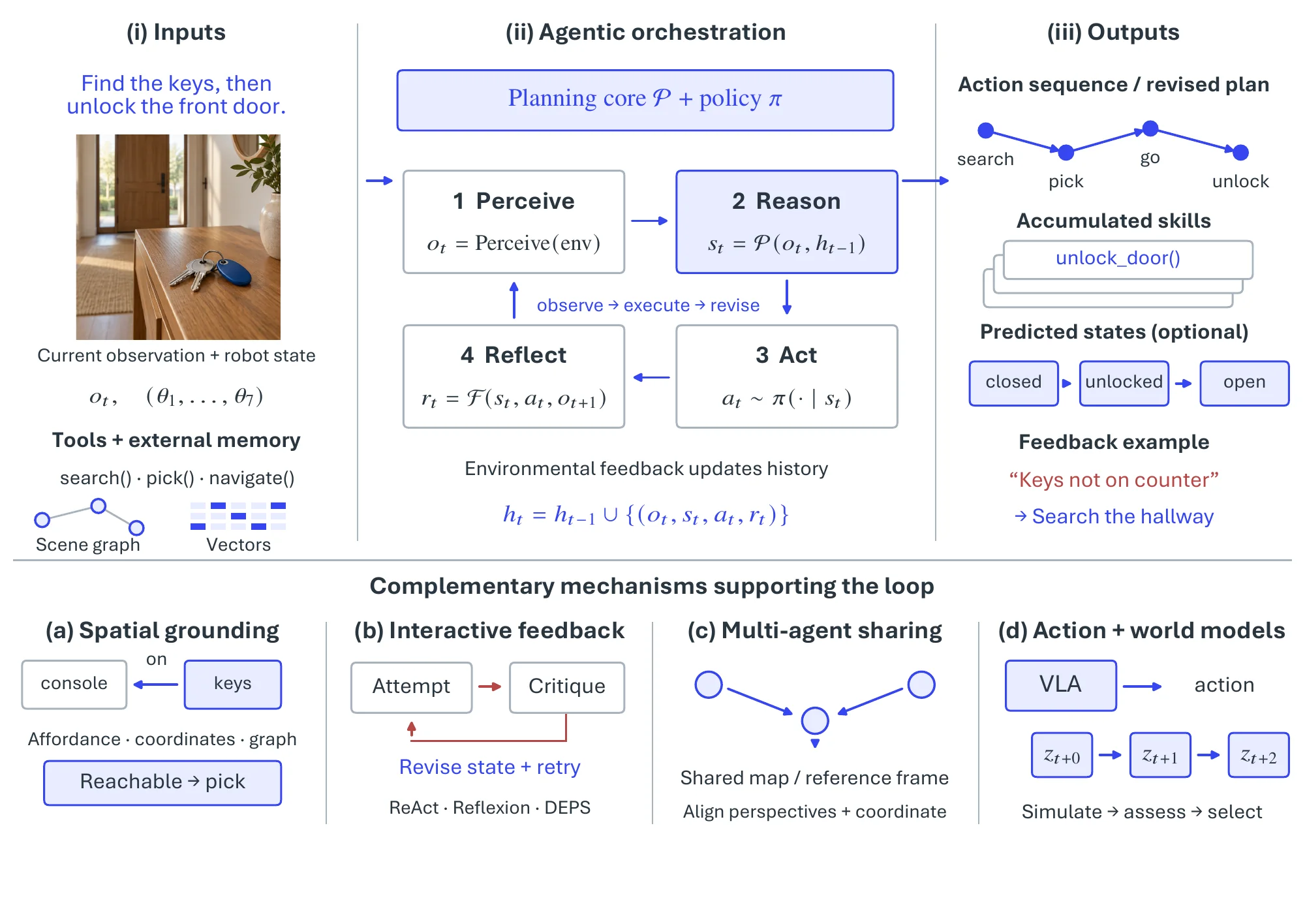
Agentic spatial reasoning asks how a model organizes interaction with space. The core object is not a single chain-of-thought prompt, tool call, memory store, VLA policy, or world model, but an orchestration policy that repeatedly decides what to perceive, what to infer, what to do, and how to revise its state after feedback. In this closed-loop view, a wall is not only a geometric plane but also a constraint on motion; a cup is not only an object category but also a potential affordance; and a failed action is not only an error but also evidence that should reshape the next plan.
“Agentic” is therefore a composition principle: the rationales, programs, tools, memory, VLA policies, and world models of the preceding subsections become resources inside a perceive–reason–act–reflect loop, and the research question is how the loop is scheduled and corrected: when should the agent gather more evidence, retrieve memory, call a geometric tool, simulate a future, ask another agent, or execute an action?
7.3.7.1Task Definition#
Whereas §7.3.5 treats tools as black-box operators and §7.3.6 treats external memory as the central learning target, agentic spatial reasoning composes both into a closed-loop cycle in which the orchestration policy itself becomes the learning target. Formally, an agentic spatial reasoning system is the tuple , where is a planning core (an LLM or VLM), is the spatial state space (perception, internal map, history), is the action space (sensorimotor commands or sub-goals), is a reflection / critic function that scores proposed actions or rationales, and is the orchestration policy. Given an instruction , the system maintains a history (initially ) and proceeds by the iterative perceive–reason–act–reflect cycle
| (7.44) | ||||||
where extracts the current spatial observation, samples a proposed action, supplies a reflection signal (verbal critique, planner-critic verdict, or value estimate), and the history accumulates all four. This formulation makes explicit that “agentic” is not a new capability but rather a structural promotion: the orchestration policy becomes the central learning target rather than the planner or any individual tool.
7.3.7.2Methodology#
Four orchestration problems organize the methods: grounding observations into executable state, closing the feedback loop, coordinating across agents, and using action and world-model modules without reducing agency to any one of them.
Grounding Observations into Executable State. The first responsibility of an agentic loop is to convert an instruction and observation into a state that can support action, preserving referential consistency between the agent’s internal model and the physical environment. Probabilistic affordance alignment, as in SayCan [1311], PaLM-E [56], and RT-2 [97], weights the likelihood of an instruction (“pick up the apple”) by the geometric feasibility of the action in the current scene; spatial reasoning stays implicit, and the orchestration layer must decide whether that is sufficient or whether to request an explicit representation. Explicit intermediate representations supply the precision implicit alignment lacks: SpatialCoT [1569] compels the VLM to output metric coordinates inside its chain of thought, a “think-coordinate-act” cycle that creates a verifiable spatial bottleneck; Embodied-R1 [1570] uses reinforcement learning to refine a pointing representation so that the model outputs 3D reference points (spatial anchors) that decouple high-level planning from motor control; and procedural querying treats the environment as a queryable database, through dynamically synthesized APIs (VADAR, §7.3.4) or a stateful code kernel that executes one cell at a time and revises the next from the observed outputs (SpatialClaw, §7.3.5). Beyond the immediate percept, agents ground reasoning in persistent structured abstractions: object-centric 3D scene graphs such as ConceptGraphs (§7.3.6) let the agent reason over topological relations (“behind”, “supported by”) rather than raw geometry, and MapGPT [1571] converts topological maps into textual prompts that give the LLM a global view of connectivity for long-horizon planning.
Closing the Feedback Loop. Agentic spatial reasoning is a temporal process rather than a single inference, and the methodological shift is from producing one rationale to maintaining a loop that observes the consequences of its own choices. The chain-of-thought paradigm (§7.3.3) improved reasoning depth but remained open-loop; ReAct [21] closed the loop by interleaving reasoning traces with executable actions so that spatial outcomes are observed before the next step is planned. Observation alone is often insufficient for correction, so Reflexion [1572] introduced “verbal reinforcement learning”, in which the agent writes explicit critiques of its failures into short-term context, and DEPS [1573] forces the agent to explain failures in geometric terms before choosing new sub-goals, turning retrying into debugging. For coherence across long horizons, agents need memory beyond the context window: Voyager (§7.3.4) stores successful spatial behaviors as executable code in a vector database and retrieves them when a similar context recurs, consolidating transient experience into procedural knowledge. Reflection can also precede execution. Reasoning via Planning (RAP) [22] and Tree of Thoughts [1502] explore branching spatial possibilities in a latent space; STMA [1539] ties such simulation to dynamic knowledge graphs with planner–critic loops that validate whether a proposed path is topologically valid; and vision-language world models such as VLWM [1574] roll out semantically described future states so that the orchestration policy can compare hypothetical futures before committing.
Coordinating Multiple Spatial Agents. In shared environments spatial reasoning becomes distributed, and movement has to be negotiated across perspectives and intents. Multi-agent reinforcement learning induces spatial cooperation without explicit communication, as in the SMAC formations learned by decentralized actor–critic and value-decomposition methods [1435] (§7.2.6), but there each agent treats the others as dynamic obstacles and has no symbolic model of its partners. A spatial theory of mind adds the ability to model another agent’s geometric viewpoint, transforming egocentric perception into an allocentric frame (“my left” is “your right”): RoCo [1575] uses foundation models for embodied dialog in which agents disambiguate spatial references by simulating the partner’s visual field, and ProAgent [1576] shows agents communicating to update a shared map and synchronize movement, converging on a common “language of space”.
Orchestrating Action and World-Model Modules. Generalist VLA policies and world models are components of agentic systems, but they do not by themselves define agency; they become agentic when an orchestration policy uses them inside the loop, with a VLA module executing a sub-goal, a world model predicting the consequence of a candidate action, and a reflection module deciding whether to retry, replan, or gather more evidence. What makes an action representation useful to a loop is that it exposes intermediate commitments the loop can inspect, revise, or hand to a controller: beyond the unified action interfaces of RT-2 [97], Gato [149], and Octo [1577], world-language-action models [1578] jointly predict textual subtasks, subgoal images, and robot actions, and ACoT-VLA [1515] reasons through coarse action intents before fine-grained control. Cross-embodiment transfer (§7.3.2; RoboCat’s self-improvement cycles adapt to new bodies [1579]) becomes an orchestration problem too, since the same high-level plan may require different perception checks, affordance tests, and recovery routines on different bodies. World models (§7.3.8), from DreamerV3 [152] and Genie [157] to WorldPilot-style prediction inside planning loops [1580], serve the loop as cognitive simulators: the agentic use is not video generation for its own sake but closed-loop decision support, in which the agent imagines, critiques, and then acts.
7.3.7.3Benchmarks#
Evaluating agentic spatial reasoning requires benchmarks that go beyond static visual question answering: a useful protocol tests whether the agent can gather missing observations, choose tools or actions, use memory across long horizons, and revise its plan after feedback, and static spatial probes should be read as component diagnostics rather than direct evidence of closed-loop agency. Two protocols exercise the loop directly: iVISPAR [1581] evaluates VLMs as agents in an interactive sliding-tile setting with visual 2D, visual 3D, and text inputs, where the answer depends on multi-step state transitions rather than one-shot recognition, and TIR-Bench [1582] requires agents to use tools (zoom, crop, rotate) to manipulate images while solving spatial puzzles. Memory-centered settings (OpenEQA [1563], §7.3.6) and open-3D probes such as Open3DVQA [1567] test what the loop must retain, and the broad visual-spatial probes (SpatialEval [1450], VSI-Bench [227], OmniSpatial [1474], Spatial-DISE [1566]) identify weak spatial primitives along the axes of static vs. dynamic content, single vs. multi-view, ego vs. exo perspective, and seen vs. unseen queried information; Table 7.5 maps the coverage.
| Benchmark | QA / Tasks | Modality | Scene | View Type | Perspective | Interactive | Query Target | ||
| Single | Multi | Ego | Exo | ||||||
| 3DSRBench [1583] | 2,772 | Image | Static | ✓ | ✓ | Seen | |||
| InternSpatial-Bench [1584] | 6,008 | Image | Static | ✓ | ✓ | Seen | |||
| OmniSpatial [1474] | 8,400 | Image | Static | ✓ | ✓ | ✓ | Seen | ||
| Spatial-DISE [1566] | 559 | Image | Mixed | ✓ | ✓ | Taxonomy | Seen | ||
| Open3DVQA [1567] | 9,000 | 3D / Sim | Static | ✓ | ✓ | ✓ | Seen | ||
| iVISPAR [1581] | Puzzles | 2D/3D/Text | Dynamic | ✓ | N/A | ✓ | State | ||
| Spatial457 [1585] | 23,752 | Image | Static | ✓ | Undeclared | Seen | |||
| All-Angles Bench [1586] | 2,100 | Image | Static | ✓ | Undeclared | Seen | |||
| EmbSpatial-Bench [1587] | 3,640 | Image | Static | ✓ | ✓ | Seen | |||
| MMSI-Bench [1588] | 1,000 | Image | Static | ✓ | Undeclared | Seen | |||
| MindCube [1472] | 21,154 | Image | Static | ✓ | Undeclared | Unseen | |||
| VSI-Bench [227] | 5,130 | Video | Static | ✓ | ✓ | Seen | |||
| VLM4D [1589] | 1,800 | Video | Dynamic | ✓ | ✓ | ✓ | Seen | ||
| STI-Bench [1590] | 2,064 | Video | Dynamic | ✓ | ✓ | ✓ | Seen | ||
| DSI-Bench [1591] | 1,700 | Video | Dynamic | ✓ | Undeclared | Seen | |||
Table 7.5 should be read as a coverage map, not as a leaderboard for agentic systems. Most entries evaluate static answer generation or localized visual-spatial primitives; only interactive protocols such as iVISPAR and tool-use settings directly exercise action selection and feedback. Claims about agentic spatial reasoning should therefore report loop-level metrics (observation gathering, action choice, recovery after failure, memory update, and final task success) rather than single-turn accuracy alone.
7.3.7.4Challenges and Trends#
Boundaries are collapsing between language and action (VLAs), between robot bodies (cross-embodiment), and between perception and imagination (world models), and two difficulties gate progress toward generalist spatial agents. The sim-to-real fidelity gap: high-fidelity simulators (predictive world models, generative video) accelerate training but introduce systematic biases that physical execution exposes, and the cost–precision frontier for transfer remains open. Long-horizon spatiotemporal coherence: across multi-hour episodes the agent’s internal map drifts, and episodic memory and reflection reduce but do not eliminate the drift, because the bottleneck is the finite context window of the planning core.
Explicit orchestration over observation–state–action–reflection tuples is one direction: VLA and WLA systems are beginning to expose intermediate subgoals, action intents, and predicted states that a loop can inspect rather than hiding all control inside a single forward pass. A second is mental simulation via generative world models: DreamerV3-style, Genie-style, VLWM-style, and WorldPilot-style models let agents verify spatial logic in imagination before acting, shifting the paradigm from “trial-and-error” toward “trial-in-imagination” while keeping the agentic focus on when to simulate, when to act, and when to revise.
7.3.8World-Model-based Spatial Reasoning#
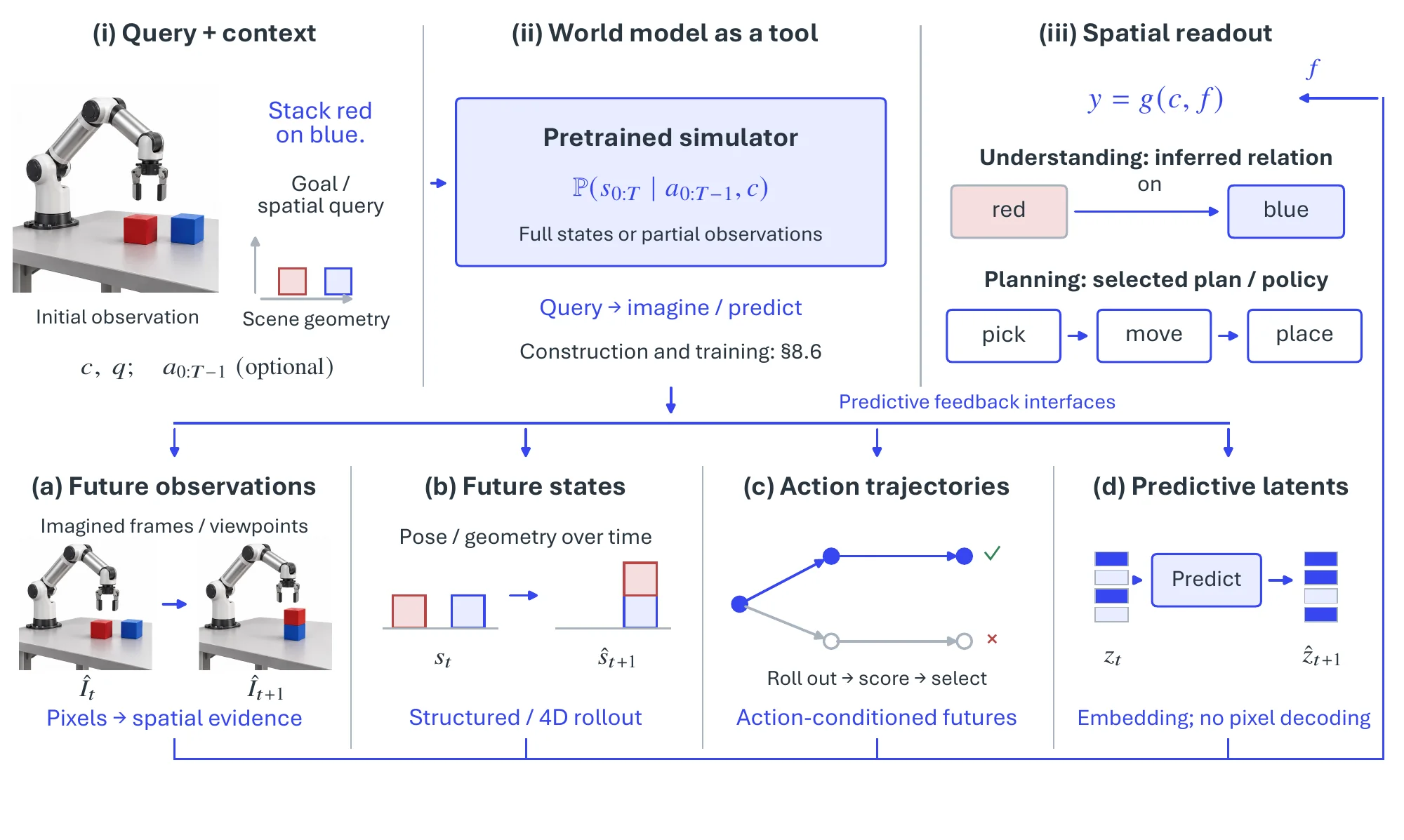
A world model is a neural simulator of how world states transition, conditioned on an agent’s actions and/or external multi-modal context. Trained on large-scale episode trajectories, it acquires a generalizable, latent model of environment dynamics. This subsection treats that model as a tool: the object of study is the spatial-reasoning task, and the world model is the instrument used to solve it. Its defining capability is that it simulates the world and can therefore return a predictive feedback signal, a rollout of imagined futures or a dynamics-aware latent, that a reasoner consumes to answer a spatial query or to plan. We accordingly organize the discussion by how the world model is queried and what feedback it returns, rather than by how it is built. The complementary question of how world models are themselves constructed, trained, and scaled is the subject of §8.6 (World Modeling); here we take a pretrained world model as given. Figure 7.28 schematizes this tool-use formulation; its two usage modes, understanding-oriented and planning-oriented, cut across the feedback forms surveyed below.
7.3.8.1Task Definition#
The task addressed in this subsection is spatial reasoning itself: given a query about a scene together with the available context (a textual description, one or more observations, or a scene specification), a reasoner must produce a spatial answer , either an inferred spatial property (e.g., , a relation, a structure, or a physical attribute) or a plan / policy that acts on the scene. What distinguishes the methods surveyed here is how they arrive at : rather than mapping to in a single feed-forward pass, the reasoner consults a world model as an auxiliary instrument that can imagine how the scene would look or evolve, and reasons over that imagined evidence. Concretely, the world model is a pretrained simulator exposing a distribution over world states , or over their partial observations when full states are unavailable, optionally conditioned on an action sequence (null when the model is action-free). A world-model-based reasoner treats as a queryable tool: given the query, it (i) conditions on the context and, when planning, on a candidate action sequence; (ii) draws predictive feedback from , a rollout of future observations, future states, or action-conditioned trajectories, or a dynamics-aware latent; and (iii) applies a readout that maps the feedback back to the spatial answer, . The world model supplies the imagined evidence , but producing the spatial answer remains the objective, and the fidelity of bounds how much the world model can help.
7.3.8.2Methodology#
We treat the world model as a pretrained instrument and organize methods by the form of predictive feedback it returns to the reasoner. Two families emerge: generative feedback, in which the model is rolled out to synthesize explicit futures that the reasoner inspects, and latent-representation feedback, in which the model’s dynamics-aware embedding is consumed directly without decoding; the understanding-versus-planning distinction cuts across both.
Generative Feedback via Future Observations. The most direct use of a world model is to synthesize future or counterfactual pixels and read spatial evidence off them, an analysis-by-synthesis strategy in which the reasoning outcome (a spatial relationship, structure, or physical property) is whatever best reproduces the observed or imagined imagery under . Predating deep generative models, Galileo [1204] instantiates this idea with a physics engine in place of a neural simulator: it tracks object velocities across raw videos and recovers 3D shape, mass, and friction as the parameters that best reproduce the observed motion, so that the projected state is the object velocity and the videos themselves define the transition distribution . Modern instances replace the engine with an Internet-scale image or video diffusion prior: DragAPart [1592], Puppet-Master [1593], ATOP [1594], and DreamArt [1595] fine-tune such priors into articulation simulators whose frames render an articulated object under a hypothesized configuration, and recover the 3D articulation (e.g., , its motion axes) by aligning the rendered hypothesis with the synthesized video. A second, inference-time use synthesizes unobserved viewpoints to resolve spatial questions that a single view underdetermines: MindJourney [202] lets a vision-language model “imagine” the scene from a new camera pose with a view-conditioned world model before answering, turning the world model into a test-time reasoning aid rather than a training-time simulator. Because such imagination is expensive and not always helpful, AVIC [1596] learns when and how much to imagine, gating world-model invocation on the sufficiency of the current visual evidence and matching or exceeding fixed-imagination strategies at a fraction of the world-model calls. Pushing imagination from a fixed sweep to an active policy, SpatialDreamer [1597] closes the loop: a reinforcement-learned agent chooses which viewpoints to imagine through the world model and then grounds its answer in the imagined evidence, under a geometric policy-optimization objective that rewards geometrically consistent rollouts.
Generative Feedback via Future States. Rather than decode pixels, a second line rolls the world model out in a structured or higher-dimensional state space, trading photorealism for geometric consistency. TesserAct [192] learns a 4D (3D-plus-time) world model whose rollouts stay spatially coherent enough to support robotic manipulation, and persistent-3D world models [1598] maintain an explicit 3D memory so that revisited regions remain consistent across long horizons. State-space feedback is attractive when the downstream query is itself geometric, since it sidesteps the appearance-modeling burden that pixel rollouts carry.
Generative Feedback via Action-Conditioned Trajectories. When the goal is to act, the world model is queried as a simulator: candidate action sequences are rolled out and scored by the favorability of the resulting states, yielding a policy that steers the episode toward a preferred terminal state (the model-based-RL view; the broader treatment of RL with spatial inductive biases is §7.2.5). The paradigm originates with Ha and Schmidhuber [4], who introduced the term “world model” in its current sense, training a generative recurrent model of future observations and using it as an internal simulator for policy search, and with Dreamer [147], which learned the simulator in a compact latent space and optimized the policy purely on imagined rollouts. Scaling this recipe, UniSim [1599] builds a video-diffusion simulator from which real-world manipulation policies can be extracted, and DreamGen [1600] uses video world models as trajectory generators, pseudo-labeling the synthesized rollouts with an inverse-dynamics model to train policies that generalize to new behaviors and environments. Most recently, VAGEN [1601] turns this feedback back onto the reasoner itself, using reinforcement learning to supervise a vision-language agent’s internal world-model reasoning: it decomposes that reasoning into state estimation (“what is the current state?”) and transition modeling (“what comes next?”) and rewards accurate latent prediction.
Latent-Representation Feedback. A final family dispenses with generation entirely and consumes the world model’s predictive latent as the spatial signal. Joint-embedding predictive architectures learn to predict the representation of a future or masked observation rather than its pixels: I-JEPA [151] establishes the recipe for images, and V-JEPA 2 [155] extends it to video, yielding dynamics-aware embeddings that support understanding, prediction, and planning without ever rendering a frame, while VL-JEPA [200] ports the idea to vision-language inputs. A related line keeps the latent explicitly geometric: 3DThinker [1602] performs 3D mental imagery during reasoning by generating a 3D latent and aligning it with that of a 3D foundation model, letting a vision-language model reason about spatial relations from only a few views without any 3D input or explicit rendering. Because the feedback is an embedding rather than an image, latent world models avoid the appearance-synthesis cost and the pixel-space memory drift that limit generative rollouts, at the price of a signal that is harder to inspect directly; they are an increasingly prominent, query-efficient alternative for spatial reasoning.
7.3.8.3Benchmarks#
Evaluation follows the usage mode. Planning-oriented use is scored on the embodied suites of §7.3.2 and on long-horizon household environments such as ALFWorld [1520] and VirtualHome [1521], where the question is whether policies extracted from imagined rollouts transfer to the real environment. Understanding-oriented use is scored on the static spatial probes that single views underdetermine, VSI-Bench [227] and MindCube [1472] among them, under test-time-scaling protocols that vary how many imagined views the reasoner is allowed and whether a verifier selects among them [1603, 1596]. The world model itself is assessed on video-generation quality (FVD, FID) together with task-specific physics-consistency probes, and surveys of general world models track the field’s shift from 2D toward 3D-consistent simulation [1604], while recent analyses argue that advancing MLLM spatial reasoning demands purpose-built recipes and data rather than scale alone [1522]. No single benchmark currently exercises a world model along perception fidelity, action conditioning, and long-horizon spatial memory at once, a gap the challenges below make explicit.
7.3.8.4Challenges and Trends#
Reading the world model as a tool clarifies where the difficulties lie: some are inherited from the instrument itself, and are properly the concern of §8.6, while others are specific to how a reasoner queries it. The most active questions of 2025–2026 are no longer whether a world model can imagine, but whether its imagined evidence can be trusted and whether consulting it is worth the cost.
Imagination is not a free lunch. Systematic probes report that world-model imagination improves spatial reasoning in only a minority of cases, and that adding imagined views yields non-monotonic, sometimes negative accuracy gains at steep token and latency cost [1596, 1603]; the sheer amount of imagination is an unreliable proxy for accuracy [1522], which recasts “when and how much to imagine” as a first-class test-time-scaling problem, with adaptive gating [1596] an early answer and a predictive account of which queries need the world model still missing. Faithfulness is the companion problem: a world model can render fluent futures that are physically or relationally wrong, so likelihood under is necessary but not sufficient, and when the imagined evidence lacks fidelity verification buys little, since heuristic verifiers give limited calibration gains and an information bottleneck sets in, as a reasoner cannot recover a signal the imagination never contained [1603]. Grounding imagined evidence to the actual scene and calibrating trust in it remain open; physics-consistency objectives and geometry-grounded latents [1602] are partial responses.
The reasoner can be no more reliable than the simulator it queries. Even state-of-the-art models such as Genie 3 [157], despite markedly longer-horizon consistency, still drift in spatial memory, and consistency mechanisms [1598, 1605] narrow but do not close this gap, with hallucination and long-horizon error compounding over rollout length; raising this ceiling is the province of world-model construction (§8.6), and the reasoning methods surveyed here can only mitigate its symptoms.
The feedback forms also trade off along different axes, with no principled account of which a given query should use: pixel rollouts are inspectable but expensive and prone to appearance drift; state or 4D rollouts are geometrically consistent but require structured simulators; latent feedback is cheap but opaque; action rollouts commit early to a policy; and most systems commit to one form a priori. Extending world-model-based reasoning beyond pixels (e.g., , to forces [1606], tactile, or audio modalities) is gated by the absence of internet-scale pre-training data in those modalities, a constraint that also surfaces in the multi-modal aspects of §7.2.6.
Two shifts define the current frontier. From external tool to trained-in reasoning: rather than invoking a frozen simulator at inference time, recent work trains the reasoner’s use of the world model, whether by reinforcement learning that supervises an internal state-estimation and transition-modeling loop [1601] or that rewards geometrically consistent active imagination [1597], or by distilling the world model’s imagined dynamics directly into a vision-language model so that no simulator need be queried at test time [1607]. From pixels to predictive latents: the imagined branch is increasingly consumed as a latent process whose hidden states guide reasoning, rather than as a faithfully rendered video [151, 155, 1602]. Both shifts move the field away from ever-larger, faithfully-rendered pixel simulators and toward cheaper, more trustworthy, query-efficient feedback that a reasoner can afford to consult, and can be trained to consult well.