10.2.1Introduction#
In entertainment, spatial intelligence is the ability to perceive and reconstruct 3D environments, objects, and human bodies, and to embed virtual content into the physical world so that it is geometrically and physically consistent. Spatial entertainment (AR games, VR experiences, location-based attractions, and virtual production for film) differs from screen-based media in that it must compute camera pose, scene geometry, and user state continuously and within strict latency limits, without sacrificing aesthetic quality or narrative coherence; the perception and reconstruction machinery involved is treated in Chapter 6 and Chapter 8.
The field has followed the same arc as the capabilities it borrows: commodity depth sensing made real-time dense mapping practical for AR games, neural radiance and Gaussian representations made captured sets photoreal and navigable, parametric body models made full-body avatars routine, and world-scale visual positioning let location-based games such as Pokémon GO anchor characters to real landmarks across sessions and players. Each of these threads returns in the pivotal tasks below.
10.2.2System Overview#
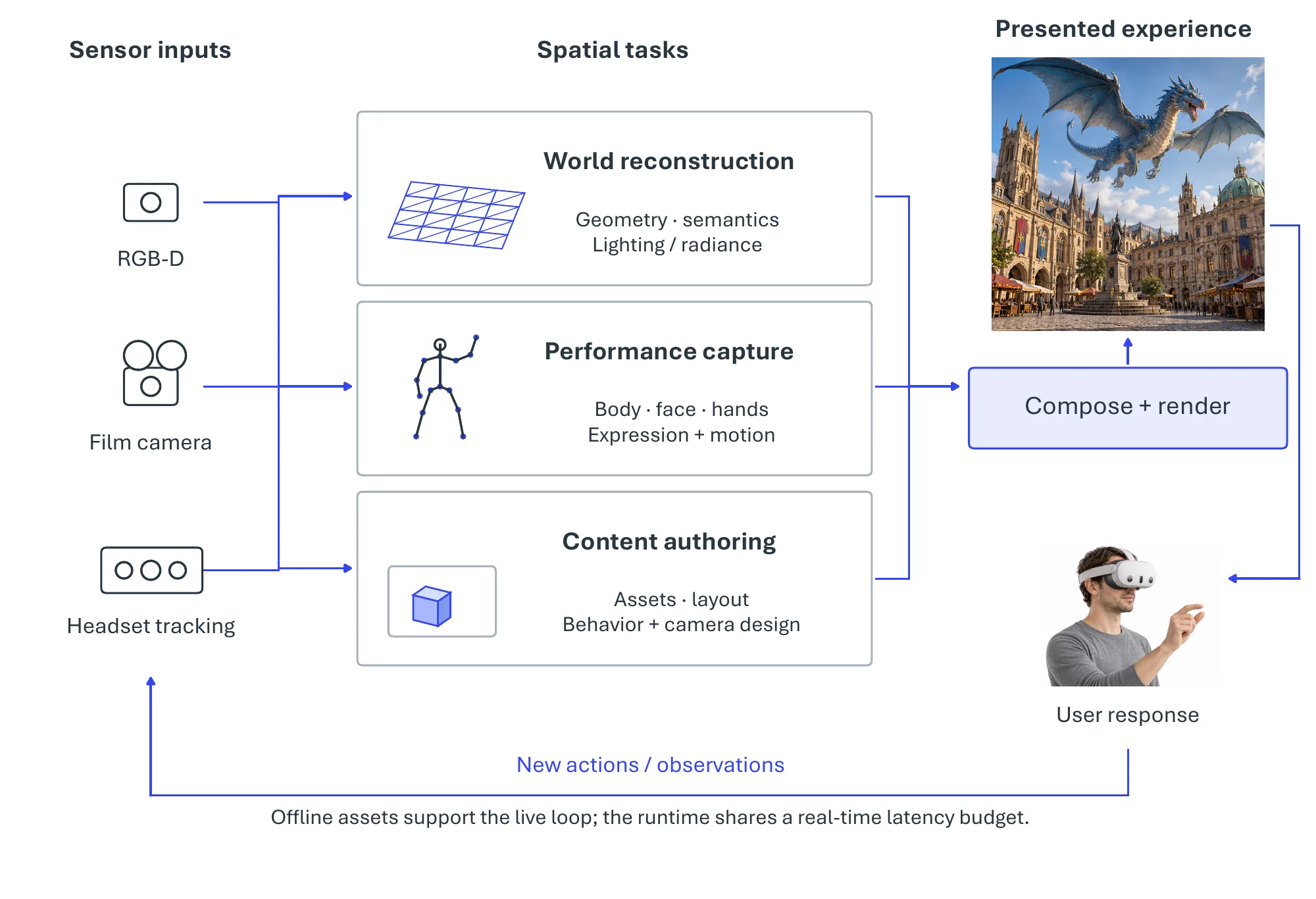
Entertainment sits on top of the XR platform of §10.1: it does not re-implement that runtime but builds on it, and its distinctive demand is production-quality spatial content, whether rendered live or authored offline. The domain spans two regimes. Real-time interactive experiences (AR games, VR titles, location-based attractions, and live virtual production) close the tight sensing-to-display loop sketched in Figure 10.5, whereas offline high-fidelity creation (scanning sets, capturing performers, building volumetric footage) supplies those experiences with assets. Across both, three spatial tasks recur as the frequent bottlenecks. World reconstruction builds the geometric and radiance model of the environment, supplying localization and occlusion for live experiences and navigable captured content for authored ones; embodied performance capture digitizes the user or performer into a controllable avatar; and spatial content authoring decides where virtual elements appear and how cameras move so that the result is both consistent and expressive. The interactive regime runs all three under hard latency budgets, while offline authoring trades that latency for fidelity.
10.2.3Pivotal Task-1: World Reconstruction and Spatial Mapping#
The first task builds and maintains an accurate, consistent model of the environment that supports localization, occlusion, and physics for live experiences and navigable content for authored ones, specializing the dense-reconstruction and scene-understanding techniques of Chapter 6 and Chapter 8 to interactive rates. Where §10.1 treated mapping as a means to on-device localization, here the reconstruction is itself the deliverable: the navigable set or stage that players and film-makers inhabit. Figure 10.6 contrasts geometric fusion, neural and point-based scene representations, and world-scale localization as complementary capabilities rather than obligatory sequential stages.
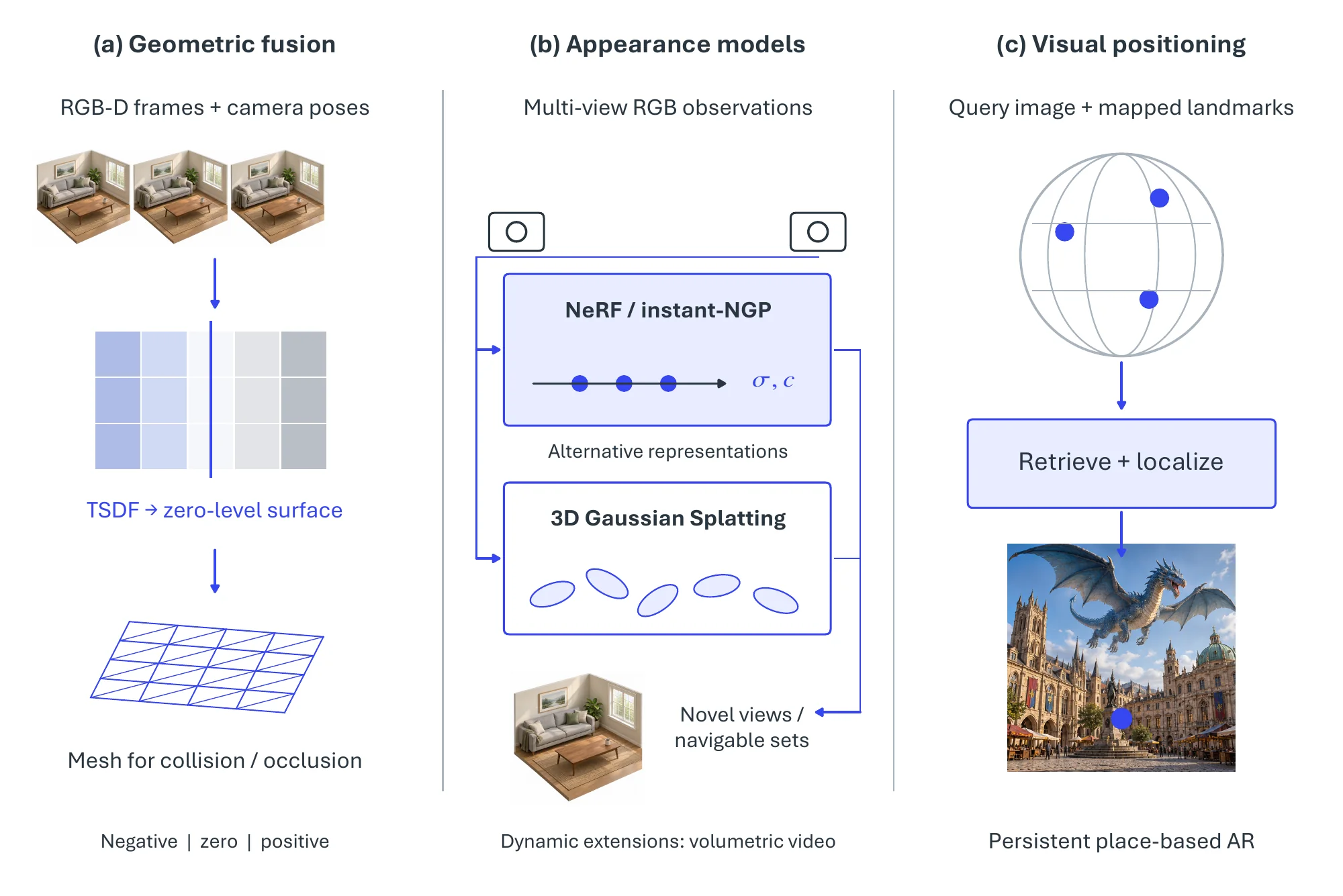
Geometric reconstruction forms the base: geometric SLAM and dense methods fuse depth or RGB data into volumetric maps, as in KinectFusion [114] and the reconstructions underlying datasets such as ScanNet [448], while DynamicFusion extends this to moving users by tracking non-rigid deformations [2660]. Neural and point-based representations such as NeRF, instant-NGP, and 3D Gaussian Splatting then represent scene radiance to produce compact, high-fidelity reconstructions that render at interactive rates [119, 120, 121]; dynamic and 4D extensions that deform or time-index the primitives carry this to moving scenes, so a performance or an entire set can be captured as free-viewpoint volumetric video for later replay [2277, 191]. At global scale, visual positioning systems (VPS) combine local reconstructions into a worldwide map that lets a mobile device localize from a single image, as in Niantic’s Lightship platform. These methods are evaluated on indoor datasets such as ScanNet and Matterport3D, which provide large-scale reconstructions with semantic labels for scene understanding [448, 340], and on NeRF-style view-synthesis benchmarks (e.g., , synthetic Blender scenes) for photometric fidelity; the latter, however, rarely capture entertainment-specific constraints such as rapid camera motion or cluttered living rooms, so practitioners often fall back on custom internal datasets (Table 10.2). The standard metrics are absolute trajectory error (ATE) for localization, surface reconstruction error for geometry, and PSNR/SSIM for neural rendering [119, 121], but in entertainment these are complemented by interaction-centric measures: the accuracy of occlusion masks, the physical plausibility of collisions, and user reports on realism (for instance, whether a virtual character convincingly hides behind a sofa).
10.2.4Pivotal Task-2: Embodied Performance Capture and Avatar Control#
The second task estimates full-body pose, shape, and facial expression to drive avatars in real time, specializing the human pose and motion machinery of Chapter 6 (and the motion-generation methods of Chapter 8) to live interaction. Unlike the sparse three-point body tracking of §10.1, driven from a headset and two controllers, entertainment capture targets studio-grade, fully-observed performance. As Figure 10.7 indicates, approaches range from skeleton-based joint prediction to surface-based model fitting and full volumetric capture.
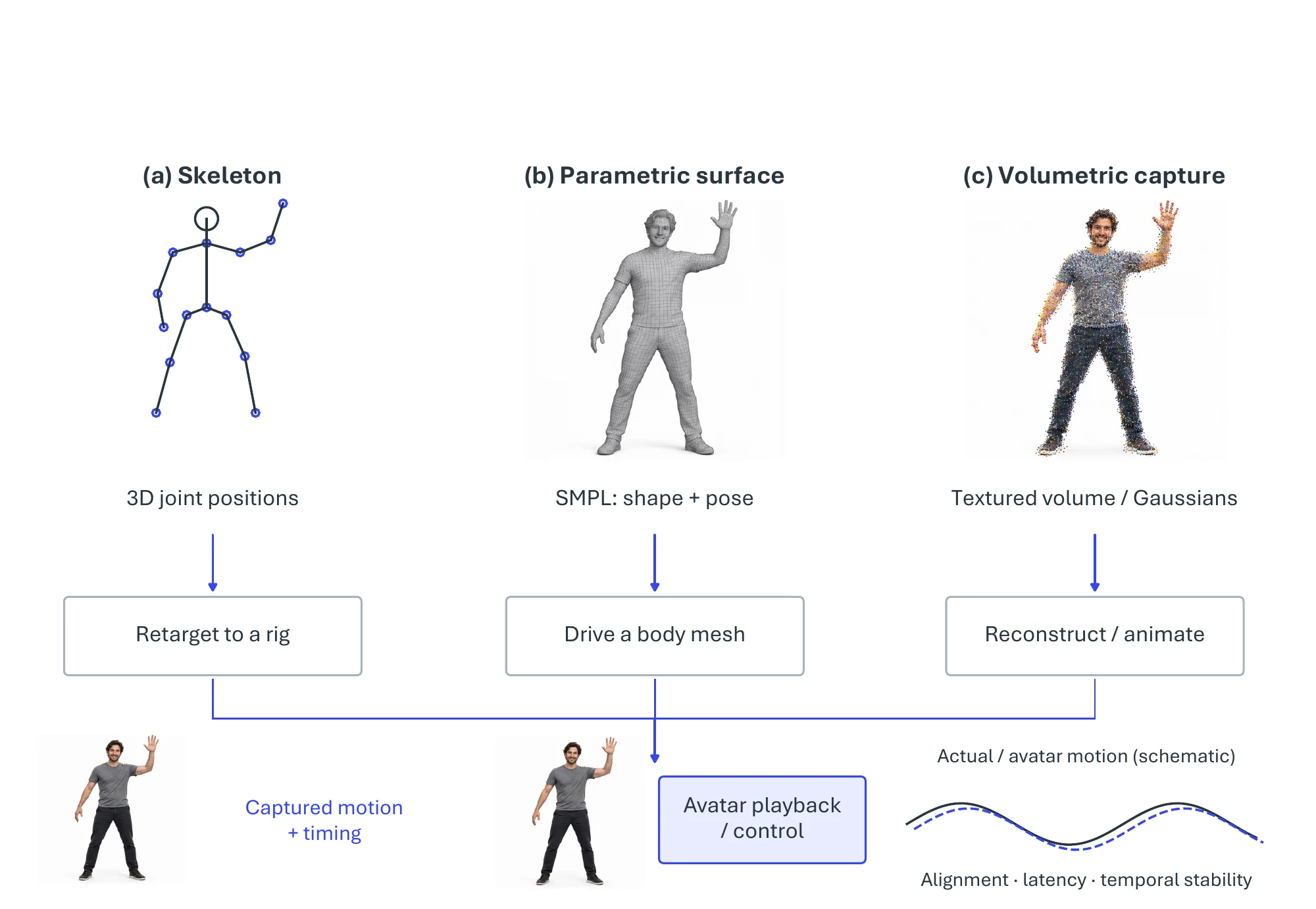
Skeleton-based methods predict joint positions from sensors, while surface-based approaches fit parametric models such as SMPL directly to video [338], with datasets like Human3.6M and AMASS supplying the supervised motion priors that make this robust [550, 2209]. Volumetric capture systems such as Holoportation go further, streaming textured 3D avatars into VR/AR scenes by combining reconstruction with tight time synchronization [221]. More recent Gaussian-splatting avatars learn drivable, photorealistic humans from multi-view capture, with rigged 3D Gaussians giving expressive control over head avatars [2661] and pose-dependent Gaussian maps modeling full-body avatars with dynamic clothing [2662], narrowing the gap between a captured performance and a real-time renderable asset. These capabilities are benchmarked chiefly on Human3.6M, which offers millions of 3D poses with calibrated cameras [550], and on AMASS, which provides over forty hours of motion data for learning priors [2209]; commercial scenarios remain underrepresented, however, since common cases such as players using controllers in small rooms or performers in costumes lack sufficient public benchmark data (Table 10.2). Quantitative evaluation uses metrics like mean per-joint position error (MPJPE), but for interactive entertainment latency and temporal stability are decisive, as even minor jitter breaks the sense of embodiment, and user studies show that enjoyment depends on the alignment between perceived and actual motion [2663]; production systems therefore pair algorithmic metrics with feedback from expert animators.
10.2.5Pivotal Task-3: Spatially-Aware Content Authoring and Virtual Production#
The third task helps creators decide where virtual elements appear and how cameras move, turning the reconstructed world and captured performers into a coherent, expressive scene, and connecting to the spatial-reasoning and planning paradigms of Chapter 7. Figure 10.8 previews the spectrum from SDK-level authoring primitives to camera-tracked LED-wall virtual production and AI-assisted cinematography.
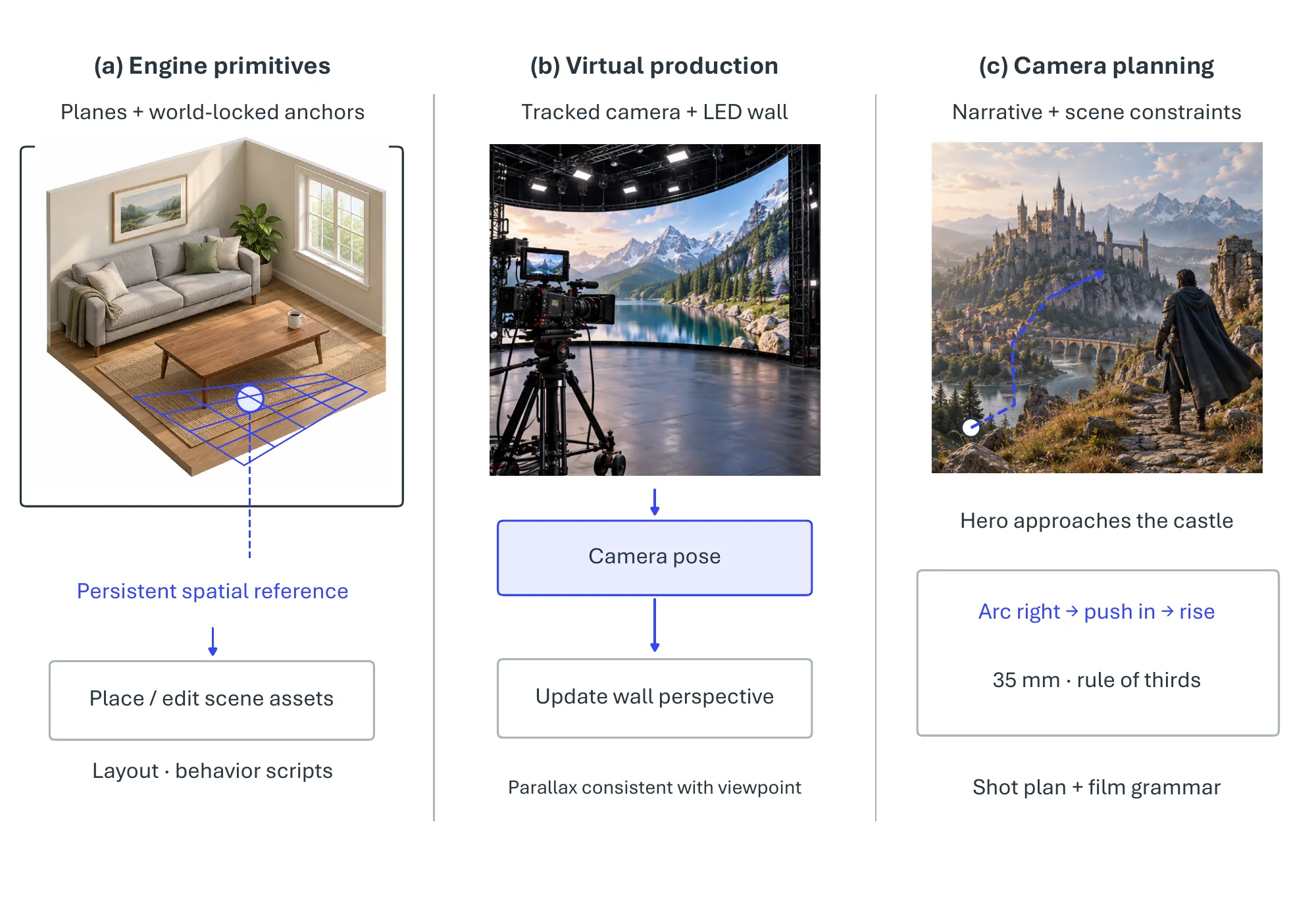
Engine-level authoring provides designers with high-level primitives such as plane detection and anchors through AR SDKs in real-time engines like Unity and Unreal. Virtual production links physical cameras to 3D scenes on LED walls so that lighting and parallax respond correctly to camera movement, and intelligent cinematography research is exploring AI-assisted camera planning that respects film grammar while adapting to dynamic user actions [2664]. Standardized benchmarks for spatial authoring are rare: some studies evaluate camera planning on synthetic storyboards, but most assessment happens internally at studios, and virtual-production workflows are typically tested on complex reference sequences rather than public datasets, which makes objective comparison of authoring tools difficult (Table 10.2). Evaluation accordingly mixes system metrics such as rendering latency with expert judgment on cinematic quality, with intelligent-cinematography studies often convening expert panels to analyze framing and continuity [2664]; for AR/VR tools usability is paramount, and HCI evaluations measure how quickly a user completes a level-design task or how rich the resulting spatial layouts are under different tool abstractions. Generative world models are beginning to bypass authoring by synthesizing playable worlds directly: GameNGen [1818] simulates the game DOOM interactively in real time with a diffusion model, and Genie 3 [157] generates navigable environments that respond to user actions, so that creating content starts to mean conditioning a world model (§8.6).
| Pivotal task | Benchmark | Representative method | Headline metric |
| World reconstruction | ScanNet [448] | Dense TSDF fusion [114] | recon. error |
| World reconstruction | Matterport3D [340] | Dense SLAM | recon. error / mIoU |
| View synthesis | NeRF-synthetic [119] | 3D Gaussian Splatting [121] | PSNR / SSIM |
| Performance capture | Human3.6M [550] | SMPL fitting [338] | MPJPE |
| Performance capture | AMASS [2209] | Motion-prior learning | MPJPE / jitter |
| Content authoring | (no public benchmark) | Intelligent cinematography [2664] | expert panel / latency |
10.2.6Established Tools and Systems#
A robust set of tools implements these tasks for games, film, and live events. At the engine level, Unity’s AR Foundation1 offers a unified API over ARKit, ARCore, and other SDKs, exposing essential features such as point clouds and depth meshing, while Google’s ARCore Geospatial API2 adds global localization, allowing applications to attach anchors to outdoor landmarks with meter-level accuracy. These abstractions let designers build AR gameplay around real-world surfaces without managing low-level sensor fusion.
Niantic’s Lightship platform packages spatial mapping and multiplayer synchronization into turnkey services: Reality Blending3 in Pokémon GO uses learned depth to let virtual creatures move behind real-world obstacles, and Pokémon Playgrounds4 extends this to persistent AR, where players leave virtual items at specific locations for others to find, with Niantic’s Visual Positioning System (VPS) keeping that content anchored consistently across users and times.
In VR gaming, consumer headsets with inside-out tracking enable room-scale interaction; games like Beat Saber use precise 6-DoF tracking to create rhythm gameplay that doubles as exercise, and studies show a strong link between spatial design choices and player exertion, underscoring the connection between tracking quality and user experience [2663]. Virtual production stages have likewise transformed film and sports broadcasting: productions such as The Mandalorian (built on ILM’s StageCraft) and sports studios such as ESPN’s Catalyst Stage5 use LED volumes driven by tracked cameras, where spatial intelligence involves calibrating physical cameras to digital scenes and maintaining low-latency tracking. Finally, neural capture tools inspired by NeRF and 3D Gaussian Splatting are entering the pipeline, letting artists scan a location with a phone and import navigable 3D assets into game engines [120, 121]; while this bridges scouting and production, it introduces new challenges around lighting control and integration.
10.2.7Challenges#
Entertainment asks for production-quality spatial content at interactive rates, and its open problems stem from that demand. The tension between real-time performance and visual fidelity is the most immediate; close behind come robustness once the system leaves controlled spaces, the cognitive load that authoring places on creators, and the human-factors and ethics questions that surface the moment these systems scan real users and real rooms.
Real-time Performance versus Fidelity. Neural representations have improved visual quality, but many methods remain too computationally heavy for mobile or standalone VR. While techniques such as 3D Gaussian Splatting achieve real-time rendering on high-end hardware [121], porting them to thermally constrained devices is difficult, and entertainment applications must additionally handle variable network conditions while guaranteeing stable frame rates, since frame drops that are acceptable in research benchmarks can cause physical discomfort in VR.
Robustness in the Wild. Existing benchmarks such as ScanNet focus on standard indoor spaces, yet entertainment experiences often occur in unpredictable environments such as festivals, dim clubs, or crowded stadiums. World-scale AR platforms address this by training on millions of crowdsourced scans, which raises questions about coverage bias (particularly toward urban areas) and the difficulty of maintaining maps as the world changes; designing models that remain robust under these shifts is an open research area.
Authoring Complexity. Although modern SDKs are powerful, creating high-quality spatial experiences imposes a high cognitive load, as creators must simultaneously manage geometry, interaction, cinematography, and technical constraints. Intelligent-cinematography tools attempt to assist by suggesting camera paths [2664], but these are not yet standard in creative workflows; there is a pressing need for tools that let designers specify high-level intentions (for example, “the character should hide behind the sofa”) which the system then realizes via underlying planning modules.
Human Factors and Ethics. Spatial systems frequently scan users and private spaces. While datasets like AMASS demonstrate the utility of large-scale motion capture, collecting similar data in the wild raises privacy concerns, and from an HCI perspective issues such as cybersickness and fatigue limit the duration of VR and AR sessions, while physically active titles introduce comfort and safety considerations that spatial layout must respect. Addressing these problems requires a collaborative approach spanning algorithm design, user-feedback systems, and clear data governance.
- https://docs.unity3d.com/Packages/com.unity.xr.arfoundation↩
- https://developers.google.com/ar/develop/unity-arf/geospatial/developer-guide↩
- https://nianticlabs.com/news/realityblending-announcement↩
- https://nianticlabs.com/news/pokemon-playgrounds↩
- https://espnpressroom.com/us/press-releases/2023/06/catalyst-stage-disneys-new-immersive-espn-studio-opens-storytelling-and-production-frontiers/↩