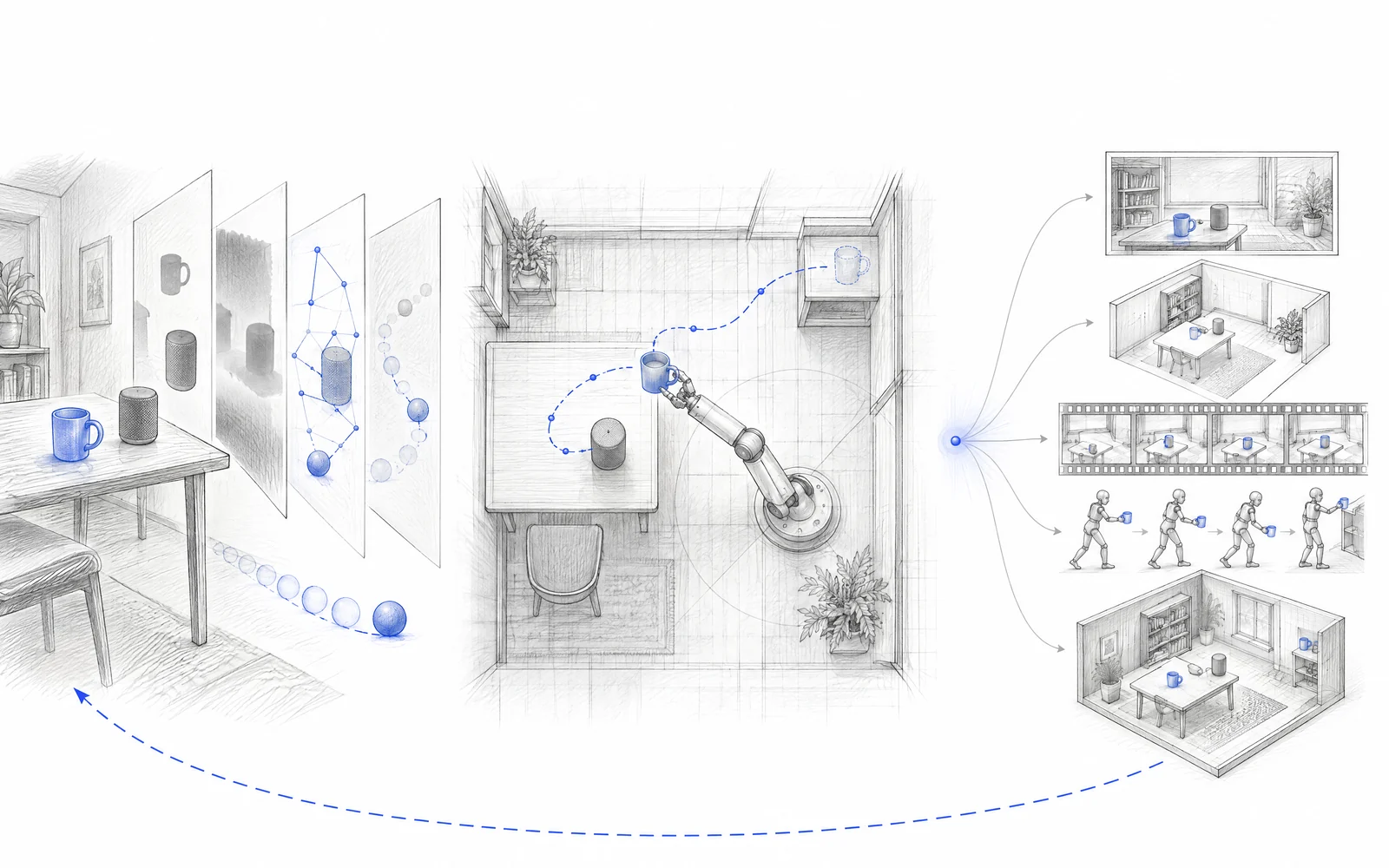
 generation runs the loop in reverse
If the previous part asked how space is represented, this one asks what a system does with that representation. Spatial intelligence, in the working sense of this handbook, is the ability to turn spatial structure into understanding and understanding into action, and it resolves into three capabilities that build on one another: perceiving space, reasoning over it, and generating it. These are less separate subfields than three phases of a single loop running from sensory input to spatial artifact.
Perception comes first because everything downstream depends on it: it converts raw observation into structured spatial evidence, answering what is present, where it lies, and how it moves. Reasoning takes that evidence as given and draws consequences from it, inferring relations, planning routes and actions, and predicting how a configuration will change under intervention. Generation closes the loop by running the process in reverse, mapping an intent (a prompt, a constraint, a partial observation) back into concrete spatial content: an image, a shape, a scene, a motion, an entire simulated world. Read in sequence, the three chapters trace the path from a scene that is given, to one that is understood, to one that is made.
Each of the three rests on the representations built in the previous part and supplies capabilities that the applications of the next will draw on; together they are the core of what makes a system spatially intelligent.